A while ago, we were invited by John Fass to come up with a play-focused brief for students of the Information Experience Design programme at the RCA. De-Computation is a theme running through a lot of the work there, so we though it would be it would be interesting to ask the students to deconstruct a logic prevalent in the games industry (F2P) and to then apply that logic to a real-world system (in this case, a London transport) service.
Outcomes
Students worked in groups on the assignment over the course of two weeks. Without a doubt, we challenged them with the assignment as it not only required them to digest a concept from a field not central to their area of study, but to also formulate a design using tools and techniques from that field. Nevertheless, we were pleasantly surprised by the outcomes. Here are some highlights.
Jaekyung Kim and Carrolynne Hsieh, going slightly off-brief by cleverly suggesting telephony transports voices, proposed a new life for London’s phone boxes in the form of a location-based free-to-play game. I am reminded of the common gesture of checking for coins left in the dispenser before making a call and like to think this design breathes new life into it. That phone boxes can be a viable platform for gaming has been shown in the past by games as I Love Bees and Nike’s GRID.


Francesco Tacchini, Michael Pecirno and Emily Groves proposed an alternative to TfL’s Oyster in the form of Golden Wheels, a tiered system sure to heighten the tention on daily commutes. Participants try to achieve gold status by playing competitive games against others. Gold users get perks such as free coffee but are required to constantly protect their status from challengers in the lower tiers. Certainly dystopian, but not that far removed from some of the shenanigans airline companies engage in on a daily basis with their loyalty programs.


The Vimeo video that was embedded here has been removed.
Below is the brief we came up with. We certainly enjoyed doing this, presenting the brief and seeing the student work afterwards. We think it could be developed further in the context of other studies and are very keen to run it again with other groups of students. If you’re an educator and this is something you’d be interested in, get in touch.
Brief
The games industry has been taken by storm by free-to-play. As a business model, its simple premise is that players do not need to pay for access to the game. A wide range of other techniques have been introduced to generate revenue instead. For example, a free-to-play MMO (massively multiplayer online game) player might pay real money to obtain a powerful in-game item without having to go through the drudgery of obtaining it in-game. In recent years virtually every game genre has been re-imagined as a free-to-play game. While clearly a commercial success, it has also received criticism. For example, people have argued free-to-play leads to exploitative game design. (In many free-to-play games a very small part of all players generate the majority of revenue.)
Experiences with digital media condition our expectations of how the world works. People might be annoyed (or relieved) to find a simple service such as a bakery operates according to something other than the free-to-play logic. On a different level, free-to-play as a ‘business model’ is a persuasive idea. Entrepreneurs, technologists, artists and designers might be seduced to imagine new products, services or experiences that operate on the free-to-play logic. For example, one could argue collaborative consumption services such as AirBnB are free-to-play. Things can be free at the point of sale when the value of the object is reimbursed in a non-monetary way.
Anything can be framed as a game. What happens when we deliberately think with a gaming mindset as we (re)design a thing? Does this trivialise the beauty of play? Is this dystopian game design?
We challenge you to deconstruct the logic of free-to-play and to apply it to a transport service operating in London. This could be a public or private service consisting of one or more modes (air, rail, road, etc.) aimed at the movement of people, animals or goods from one location to another. Reinvent such a system so that it becomes free-to-play. In doing so, we will ask and possibly answer the question: Who does the code of free-to-play compute for? The player, or someone/something else?
Suggested activities:
- Visually map the networks of actors and interactions of both free-to-play games and the transport service of your choice.
- Cross-breed and mutate such networks, inventing new forms of play.
- Rapidly prototype your system. Physically act it out; body-storm, don’t brainstorm.
- Write up your free-to-play system as the rules of a physical game. Test it for intelligibility.
- Design and produce the materials required for your free-to-play system.
- Tell a short visual story of a person’s experience with the system.
Suggested reading


Week 233
This week was all about Lift 14. Alper and I traveled to Geneva on Tuesday. We prepped our workshop at a local coworking spot and later at our apartment.
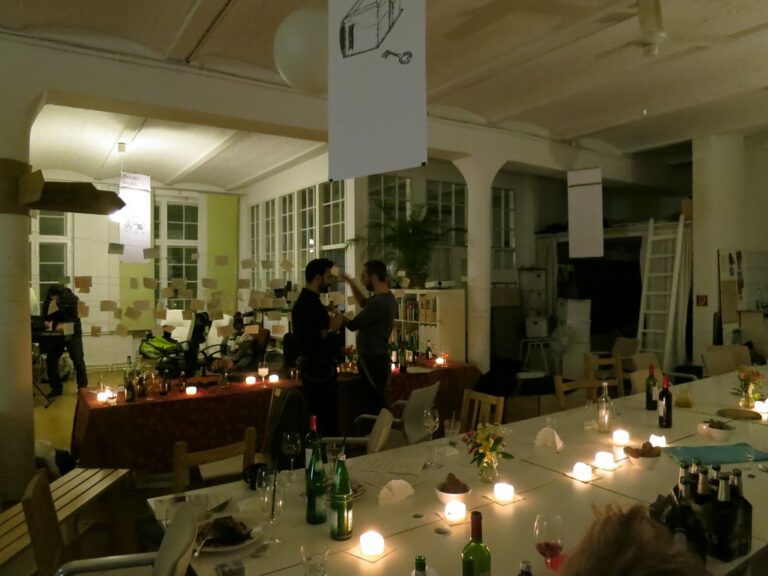
The next morning, we ran Playing with Rules. We followed roughly the same format as at Mozilla Festival last year, slightly adjusted based on feedback from some of the participants from back then. We had a nice group with a varied background. There were less people with game design experience this time around, which was fine as we have training wheels built into the format. Outcomes were interesting, including one game about road rage with some mechanics that actually generated traffic jams on the board.
In the reflection during the wrap-up we discussed things like how to argue with games, how with applied games it’s not so much about being realistic as it is about interesting. We also observed that some issues seem to naturally emerge from the starter game we picked, things like immigration, traffic, discrimination. It might be interesting to swap out Mens erger je niet! for something else next time. The main point of the workshop—the importance of iteration and the importance of experiencing a design first-hand as soon as possible—clearly came across.
After the workshop, Lift 14 kicked off in ernest. On the first day, I particularly enjoyed Alexis Lloyd’s criticism of seamless design, the making-of of the first lab-grown hamburger and gorgeous still and moving images produced by Lia Giraud using algae.
That evening, we headed to the traditional Lift fondue, ate lots of cheese and drank a sufficient amount of wine. Good conversations were had.
During the remained of the conference, we found some time to play around with the work on display at the exhibition, including a demo of third-person perspective live video goggles by OuterBody Labs (which reminded me of 3RD by Monobanda) and neat retro-compatible games and playful interfaces made by HEAD media design students.
Towards the end of the conference we were treated to two excellent talks on algorithmic culture. Ian Bogost revealed how the algorithm has become a dominant metaphor of our time, highlighting but also obscuring certain aspects of the world, such as the fact that much work still involves humans, even when we think it’s just code. (I was reminded of recent reads Metaphors We Live By and We Have Never Been Modern.) Dan Williams took us on an enjoyable tour of what it means to be a maker in a world dominated by the algorithm, and arrived at similar conclusions. Making things—physical things especially—is still messy and a lot of work. It won’t do to defer all responsibility for how the world is organised to engineers or even designers. Reality is messy and demands equally messy assemblages of disciplines to deal with it.
We would depart on Saturday, but not before we were treated to a genuinely mind-blowing tour of CERN, including a visit to the control centre and down below to the LHC. It’s amazing to think humans are capable of projects of such enormous scale and encouraging to know science can bring nations together to jointly pursue such peaceful ends. James Bridle wrote a nice thing about this after his visit two years ago. I’ll leave it there, and let the photos below speak for themselves.