Hubbub has gone into hibernation.

Speaking at dConstruct 2011

I am real­ly pleased to be speak­ing at dCon­struct this year. I’ve attend­ed the con­fer­ence myself sev­er­al times and always enjoy the well-curat­ed pro­gram and the good things offered by the even­t’s home, love­ly Brighton. You’ll find the abstract I sub­mit­ted below. Have a look at the con­fer­ence site for the rest of the pro­gram — which is stel­lar, I’m hon­ored to be part of it — and make sure to grab a tick­et once they go on sale on July 5th.

When you think of a city, what is the first thing that comes to mind? Most like­ly it is the stuff that it is made up of: its streets and build­ings, its parks and squares. But what sets a city apart, aside from its archi­tec­ture, is how all that stuff is put to use. A city’s nightlife, a city’s cui­sine, a city’s cul­ture. In oth­er words, what peo­ple make of the space they live in when they are at play.

Play isn’t lim­it­ed to the “soft side” of urban­ism. In fact, it turns out a build­ing isn’t some pre­fixed struc­ture capa­ble of doing one thing only. Adap­ta­tion and reuse con­tin­u­ous­ly trans­form what a city’s archi­tec­ture is for, often from the bot­tom up. In this way, a city’s peo­ple shape their homes as well, quite lit­er­al­ly.

What is at work in this process of city trans­for­ma­tion, is noth­ing less than play. In cities, just as in games, peo­ple and the space they inhab­it shape each oth­er. Thus, in our West­ern cities, where reuse is over­tak­ing con­struc­tion of new space, we are all becom­ing archi­tects.

In this ses­sion Kars looks at how game cul­ture and play shape the urban fab­ric, how we might design sys­tems that improve people’s capac­i­ty to do so, and how you your­self, through play, can trans­form the city you call home.

Posted in Upcoming | Tagged , , , , , , , , | Comments closed

Things we’re working on (volume 2)

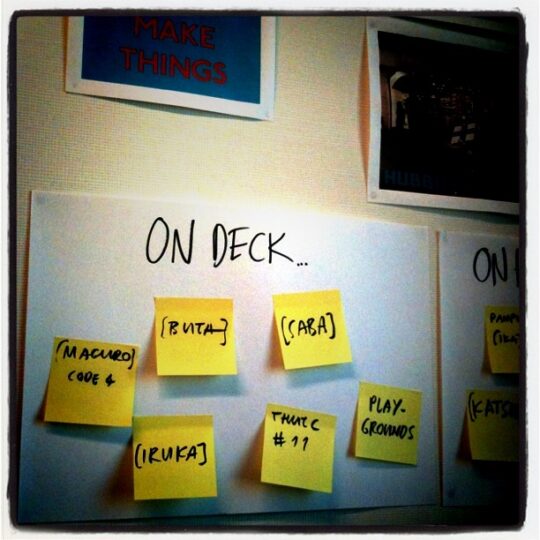
On deck

It’s been over half a year since I last talked about the projects we have on deck. I thought I’d do a quick post to give you a sense of what’s going on.

  • We’re in the process of wrap­ping up Maguro. The game — titled Code 4 — is fin­ished and has seen sev­er­al suc­cess­ful runs already. Since this is a game that runs inter­nal­ly at the Dutch Tax Admin­is­tra­tion, we’re work­ing to pro­duce some addi­tion­al mate­ri­als that illus­trate the play­er expe­ri­ence. We’ll also talk about the game at Chi Sparks, and (hope­ful­ly) at this year’s DiGRA con­fer­ence; Think Design Play.
  • Buta — the game for pigs and humans that we’re work­ing on with the HKU’s DPI research group — is con­tin­u­ing at a steady pace. We’re plan­ning the shoot for the video-sketch at the moment. With a lit­tle luck we’ll be able to share it by the end of sum­mer.
  • Project Kat­suo — best described as a casu­al LARP with a time trav­el theme — has emerged from con­cept stage and we are now at a point where we think we might have an inter­est­ing game on our hands. It’s an inter­nal research project, so it might take a while before it sees the light of day, but I’m hop­ing we can share the out­comes of it some­time this year.
  • Iru­ka is a new project sched­uled for the final quar­ter of this year. We’ll be invent­ing new ways of using games in mid­dle edu­ca­tion for a pub­lish­er of teach­ing mate­ri­als. We’re col­lab­o­rat­ing with a mid­dle school so we can do exper­i­ments in the class­room. The games will focus on teach­ing sci­ence.
  • Final­ly, Saba is also a new project, start­ing in July. We’ll be pro­duc­ing a game for the vis­i­tors of a sci­ence muse­um with the aim of get­ting them in a sci­en­tif­ic mind­set.

So it looks like we’ll be keep­ing busy the com­ing months. I am excit­ed about the sci­ence theme run­ning through a few of these projects. It’s an oppor­tu­ni­ty to devel­op some of our ideas around sys­tems lit­er­a­cy fur­ther.

Posted in Projects | Tagged , , , , , , , , , , , , | Comments closed

Talking about Code 4 at Chi Sparks

Our long­time col­lab­o­ra­tor Alper Çuğun will be at Chi Ned­er­land’s bi-annu­al con­fer­ence to talk about Code 4 (for­mer­ly referred to as Maguro). Code 4 is a per­va­sive game we cre­at­ed for the Dutch Tax Admin­is­tra­tion with the aim of ignit­ing orga­ni­za­tion­al change.

Chi Sparks is a con­fer­ence that focuss­es on “the very impor­tant con­tri­bu­tions that good HCI research makes in real­iz­ing suc­cess­ful, inno­v­a­tive, new prod­ucts or ser­vices that have a gen­uine impact on people’s lives.”

I think with Code 4 we man­aged to have a real impact on the orga­ni­za­tion and its employ­ees. So I am pleased we can share our work with peers in the HCI com­mu­ni­ty.

Below is the abstract. There’s a few more inter­est­ing ses­sions on games and play that we are part of. Get your tick­ets fast, ear­ly bird reg­is­tra­tion ends June 6.

Pro­mot­ing orga­ni­za­tion­al change with­in large gov­ern­ment bod­ies remains an elu­sive goal. The game Code 4 was devel­oped to cre­ate a coher­ent ful­ly mixed media approach to elic­it­ing orga­ni­za­tion­al change effects by employ­ing employ­ees as the pri­ma­ry actors (play­ers) in a game. The Code 4 game was set in an anal­o­gous world but with a clear cause to action in a dystopic finan­cial cri­sis and with rules that mir­rored but also sub­vert­ed exist­ing bureau­crat­i­cal process­es. The game­play reward­ed suc­cess­ful col­lab­o­ra­tion with­out regard for the orga­ni­za­tion­al frame­work. Results indi­cate that many play­ers were whol­ly engaged with both the core game as with the sup­port­ing encoun­ters and that the trans­fer­ral of game effects was suc­cess­ful. Employ­ing a game for orga­ni­za­tion­al change has proved itself to be a valid approach.

Posted in Upcoming | Tagged , , , , , , | Comments closed

New Games for New Cities at FutureEverything

Last week I was in Man­ches­ter for FutureEv­ery­thing. I pre­sent­ed on games and how they can be used to improve city life. Below are my notes and a selec­tion of slides. It’s longish, but hope­ful­ly infor­ma­tive. I’ve tried to con­nect crit­i­cism of gam­i­fi­ca­tion with the virtues of open-end­ed play, and show how the lat­ter can build skills that are use­ful for good urban liv­ing. Thanks to Greg, Kevin and Drew for hav­ing me and for orga­niz­ing such a won­der­ful con­fer­ence. I enjoyed my stay in Man­ches­ter, the patch­work of indus­tri­al her­itage and thor­ough­ly mod­ern archi­tec­ture pro­vid­ed me with some inter­est­ing scenery for walk­ing the city. Any­way, read on for the talk.

Think back to your child­hood. What did you play with? My mom is a preschool teacher. So when­ev­er I was bored we were giv­en clay, wax crayons or card­board. Lat­er on I got heaps and heaps of LEGOs. And I drew a lot. Lots of play for me and my broth­er and sis­ter con­sist­ed of cre­ative play.

My friends how­ev­er, they had He-Man… and Trans­form­ers and lat­er on M.A.S.K. Remem­ber M.A.S.K.? I was so jeal­ous of them. I always want­ed to have those. I some­times went over to play with them. And it was fun, no doubt. But at the end of a play ses­sion like that, we wouldn’t have made much. Per­haps we would have told a few sto­ries. But they tend­ed to be odd­ly sim­i­lar to the car­toons these toys are based on.

Futureeverything 007 005

The cray­olas and the He-Man toys rep­re­sent two very dif­fer­ent types of tools for play. One is about open-end­ed play, and the oth­er is about pre-script­ed play. One is cre­ative, pro­duc­tive or even trans­for­ma­tive. The oth­er is con­sump­tive, con­fir­ma­tive or even pre­scrip­tive. It is my opin­ion that what the world needs right now is for us to play more with the for­mer – the cray­olas – and less with the lat­ter – the image-focused toys. Because the types of skills we devel­op as we play with the cray­ola-like toys of today, are the types of skills we can use to address some of the issues we’re faced with in con­tem­po­rary and near-future cities.

Futureeverything 007 006

Put dif­fer­ent­ly, one kind of play is about the actions you engage in. The oth­er is focused on the thing. It’s the dif­fer­ence between this adven­ture play­ground, where kids have built their own cas­tle, and the play­ground on the right, where kids are pro­vid­ed with one. You can see the for­mer requires very dif­fer­ent skills from the lat­ter.

Let’s talk a bit more about those skills, shall we? It turns out open-end­ed imag­i­na­tive play builds a set of skills col­lec­tive­ly known as exec­u­tive func­tion.1 I use the term “skill” loose­ly here, it’s actu­al­ly a con­cept “used by psy­chol­o­gists and neu­ro­sci­en­tists to describe a loose­ly defined col­lec­tion of brain­process­es that are respon­si­ble for plan­ning, cog­ni­tive flex­i­bil­i­ty, abstract think­ing, rule acqui­si­tion, ini­ti­at­ing appro­pri­ate actions and inhibit­ing inap­pro­pri­ate actions, and select­ing rel­e­vant sen­so­ry infor­ma­tion.”2 An impor­tant part of exec­u­tive func­tion is self-reg­u­la­tion. Self-reg­u­la­tion is what chil­dren devel­op when at social, imag­i­na­tive, unplanned unsu­per­vised play. Sim­ple things like a game of hide and seek, per­haps with some social­ly nego­ti­at­ed rules thrown in.

When no-one is telling you what to do…

So open-end­ed play builds self-reg­u­la­to­ry capac­i­ty in kids. But that capac­i­ty car­ries on into adult­hood. It’s this capac­i­ty you use to over­come obsta­cles, to mas­ter cog­ni­tive and social skills and to man­age your emo­tions. It’s the stuff that kicks in when no-one is telling you what to do. Vital stuff in today’s atom­ized, hyper-indi­vid­u­al­ized world. At least, if you want to live well, and want to live well with oth­ers.

The prob­lem is, few­er and few­er of children’s play­time is unsu­per­vised and unplanned. In fact it has been co-opt­ed and com­mer­cial­ized to a large extent. This has been going on for decades. It start­ed with things like this, Mattel’s toy gun called the Thun­der Burp. No longer did you need to build your own gun from twigs or tub­ing and use your imag­i­na­tion to fill in the rest…

Futureeverything 007 009

And this co-opta­tion of chil­dren’s play by cor­po­rate inter­ests has tak­en on grotesque forms now, such as in this thing called KidZa­nia…

Futureeverything 007 010

KidZa­nia is a the­mepark that offers chil­dren an “edu­ca­tion­al expe­ri­ence”. It’s a child-sized con­sumerist utopia where kids play at hav­ing var­i­ous jobs, such as flip­ping burg­ers or work­ing in a print shop. They earn Kid­Zos which they can deposit at a bank and use to pay for oth­er activ­i­ties or phys­i­cal items. Most of the activ­i­ties are spon­sored by large cor­po­ra­tions – the parks would not be finan­cial­ly fea­si­ble oth­er­wise. So the burg­ers activ­i­ty for instance, is spon­sored by a cer­tain fast-food chain fea­tur­ing gold­en arch­es. And here kids are “play­ing at” fill­ing a coke bot­tle.

Futureeverything 007 011

There are KidZa­nia parks across the world, in Mex­i­co, Japan, Indone­sia, Korea, Por­tu­gal and Dubai. There’s a ton more being planned to open. Of course KidZa­nia mar­kets to par­ents, who, dri­ven by the urge to give their child the very best upbring­ing they can afford, can’t resist. As a result, chil­dren are brain­washed to be good con­sumers with cor­po­rate jobs. All in the name of “edu­ca­tion”. I’m not say­ing the par­ents are blame­less, and sure­ly my per­son­al pol­i­tics are shin­ing through here, but I do believe this is a strik­ing exam­ple of how we have come to see play.3

Let’s return to the adventure playground

We see play as some­thing that enter­tains. Some­thing you con­sume. In any case, recall the impor­tance of exec­u­tive func­tion, of self-reg­u­la­tion, and how it is trained through open-end­ed play. Now think about the types of play chil­dren – and adults – are being pro­vid­ed with. What we need is the oppo­site of what we are giv­en. So let’s return to the adven­ture play­ground.

Now, we have sev­er­al gen­er­a­tions who have grown up with less prac­tice at self-reg­u­la­tion. That includes myself and quite a lot of you out there today. At the same time, our world has got­ten more com­plex. Deal­ing with all this com­plex­i­ty actu­al­ly demands more self-reg­u­la­to­ry capac­i­ty from us.

When I say com­plex I don’t just mean com­pli­cat­ed. I mean we’re con­tin­u­ous­ly deal­ing with sys­tems made up out of small parts inter­act­ing in var­i­ous ways. In aggre­gate we can­not pre­dict the out­comes of those inter­ac­tions. An exam­ple we can all relate to is the recent glob­al cred­it cri­sis. It is tempt­ing to think it was the result of the shenani­gans of a few irre­spon­si­ble bankers. But in truth, it was the result of a huge­ly com­plex system’s fail­ing. Our actions as home own­ers have cer­tain­ly con­tributed to the ulti­mate cat­a­stro­phe. It’s hard though to see how our indi­vid­ual choic­es can lead up to such events.

It’s the but­ter­fly effect, a seem­ing­ly minor event lead­ing to sig­nif­i­cant out­comes. Like Edward Lorenz said: “Does the flap of a butterfly’s wings in Brazil set off a tor­na­do in Texas?” I think we can all become bet­ter but­ter­flies, with more sense of how our actions con­tribute to the whole. This will not hap­pen through top-down con­trol. It requires self-direct­ed work from all of us.

But with less self-reg­u­la­to­ry capac­i­ty, we’re less able to moti­vate our­selves in the work we do, and the oth­er activ­i­ties life con­fronts us with. And we got here, at least in part, thanks to the co-opta­tion of open-end­ed play. What I find per­verse is that there are peo­ple who pro­pose to use the same planned, pre-script­ed play to increase our ‘engage­ment’ with what­ev­er is the work at hand. It is now often called gam­i­fi­ca­tion. But it start­ed with rel­a­tive­ly benign stuff like these loy­al­ty cards. I think, if we go down this route, we’ll be in more trou­ble than we already are. In stead, we should be help­ing peo­ple devel­op those self-reg­u­la­to­ry skills so they them­selves can trans­form what­ev­er con­text they are faced with.

Futureeverything 007 017

I have many issues with gam­i­fi­ca­tion. There have been plen­ty of sol­id retorts on many lev­els by lots of peo­ple smarter than me.45 But let me offer two points of my own: one, gam­i­fi­ca­tion forces peo­ple to play. And two: it indis­crim­i­nate­ly slaps reward sys­tems on tasks both shal­low and deep. It risks hol­low­ing out intrin­si­cal­ly reward­ing activ­i­ties.

Futureeverything 007 018

My pal Karel here has a keen sense for this. When I gave him this Ako­ha card after treat­ing him to cof­fee and hav­ing a nice con­ver­sa­tion, he was far from charmed. In fact he was insult­ed. This pho­to was tak­en short­ly before he tore up the card, pre­vent­ing me from cash­ing in my points. In his view, hav­ing a cup of cof­fee with a friend is worth the trou­ble in and of itself. I shouldn’t need a game to go through the trou­ble. And you know what? He’s right.

It’s also the case that where­as true play is always engaged in vol­un­tar­i­ly, many gam­i­fi­ca­tion designs leave you with no choice. You are con­front­ed with a sys­tem you must use for util­i­tar­i­an rea­sons, and now you are asked to jump through addi­tion­al hoops so that you will be more “engaged”. You do not play a gam­i­fied sys­tem, this sys­tem is play­ing you. It starts with sim­ple things like the vir­tu­al plants on the right of this Ford Fusion Hybrid’s dash­board…

Futureeverything 007 019

…and it ends with at least mild­ly wor­ry­ing things like My Coke Rewards, which incen­tivizes the con­sump­tion of Coca-Cola.

In addi­tion, mak­ing good games is hard. Con­sid­er the many mediocre games on the mar­ket. Here’s a few of them list­ed on Meta­crit­ic. Do you real­ly want your bank­ing sys­tem to be gam­i­fied by some well-mean­ing but bliss­ful­ly igno­rant design­er who has been asked to “just add points”?

Gamification won’t save us

So I’m sure it’s clear at this point that I do not believe gam­i­fi­ca­tion will save us. It adds points and badges to the sys­tems we suf­fer under every­day, with­out actu­al­ly fun­da­men­tal­ly address­ing their nature. One thing I think we need to do is to take up that gaunt­let. And when it comes to games and the com­plex city life we live nowa­days, I think we should be focus­ing on the peo­ple in the city, in stead of the stuff. Because it is ulti­mate­ly the behav­ior of the peo­ple that shapes the city, all the way to its built form. And games are excel­lent shapers of behav­ior.

The things that make life worth liv­ing in any city are non-script­ed. Some call it city­mag­ic. It is the joy that results from hav­ing such a high con­cen­tra­tion of peo­ple in one place, all going about their busi­ness each with their own hopes and desires. Good cities are those where cit­i­zens feel they have the agency to do this, and where they are not afraid of unfore­seen con­se­quences to their actions. It’s like Jane Jacobs said:

“Cities have the capa­bil­i­ty of pro­vid­ing some­thing for every­body, only because, and only when, they are cre­at­ed by every­body.”

Now, the net­worked city makes this chal­leng­ing for us. Many if not all aspects of life are now struc­tured by infor­ma­tion tech­nol­o­gy and much of that tech­nol­o­gy is find­ing its way into the built envi­ron­ment. The trou­ble is, to the ordi­nary cit­i­zen the process­es that are influ­enc­ing our lives so strong­ly are opaque, and often inscrutable. Like this CCTV cam­era, which is designed in such a way that you can­not tell wether it is aimed at you or not…

Futureeverything 007 024

One way to address this is to bring bet­ter design to those urban infor­mat­ics. This is a worth­while endeav­or and I am glad super smart folks are engaged in it. My propo­si­tion though, is that games can con­tribute to the build­ing of the self-reg­u­la­to­ry skills that cit­i­zens need to both bet­ter read and write the con­tem­po­rary city.

Literacy of the networked city

This lit­er­a­cy of the net­worked city is some­thing that resides in peo­ple, not things. And I think games and play are an excel­lent train­ing ground for this kind of lit­er­a­cy. I’ll give you an exam­ple in a minute, but before I do, remem­ber that what makes cities mag­i­cal is all those peo­ple you do not know. The serendip­i­tous encoun­ters and the great things they are up to. And that, to live well in the city, it is of the essence to give each oth­er the much need­ed space to do this. To real­ize, in oth­er words, that strangers are your friends, with­out them actu­al­ly hav­ing to be your friends.

Recent­ly I par­tic­i­pat­ed in my first all­ey­cat. They’re scav­enger­hunt-like races orga­nized by bicy­cle couri­ers and cycling enthu­si­asts. You typ­i­cal­ly ride them on one of those fash­ion­able fix­ies. It was a love­ly expe­ri­ence.

Futureeverything 007 027

Not only is it a great way to serendip­i­tous­ly explore the city, but it’s also a love­ly struc­ture for inter­ac­tion with strangers. I wasn’t too famil­iar with the city, so I tagged along with a few oth­er rid­ers who had a nice pace. We roamed the streets like a pack of stray dogs and flu­id­ly weaved through traf­fic.

Futureeverything 007 028

Some of these guys real­ly have super­hero-like skills when it comes to wayfind­ing and read­ing traf­fic. It was men­tal­ly expand­ing to wit­ness. After­wards we had a beer, a chat and then we went our sep­a­rate ways.

Futureeverything 007 029

The point is not that these games turn you into instant friends. In stead, the point is that you’re remind­ed that any fel­low cit­i­zen can be the occa­sion­al team mem­ber, some­one you hook up with to achieve some­thing, and that’s it. That’s an impor­tant real­iza­tion for any urban­ite to have.

Futureeverything 007 030

More inter­ac­tions with strangers: at one point dur­ing the race I round­ed a cor­ner and there was a group of chil­dren at a tram stop cheer­ing us as we came past. For a moment I felt like Lance Arm­strong, and I am sure they were play­ing at what they had seen on TV. Smiles all around. So play­ing a game like this builds skills, and real­iza­tions, any urban­ite needs to bet­ter deal with strangers.

Futureeverything 007 031

The ques­tion is, what the all­ey­cat of trans­mo­bil­i­ty looks like. How do we race each oth­er when we’re using our Boris Bikes and our Oys­ter cards to hop from modal­i­ty to modal­i­ty? Per­haps it’s Chro­maro­ma, per­haps it’s some­thing else, but in any case, we need these games and we need our sys­tems to accom­mo­date them.

When the now still ana­logue wayfind­ing sys­tem in the tube is replaced by a piece of urban infor­mat­ics, I want it to still allow for this kind of stuff. Because it’s these lit­tle things that make our cities such won­der­ful places to live in.

Futureeverything 007 033

It’s the age-old dilem­ma of city plan­ners; plan­ning for the unex­pect­ed. Antic­i­pat­ing, for instance, what this free run­ner is doing with these street lights, is next to impos­si­ble. Attempt­ing to plan for it is almost para­dox­i­cal. But it’s vital. Because in addi­tion to build­ing use­ful skills for urban liv­ing, self-ini­ti­at­ed play like this, the things peo­ple get up to with­out top­down insti­ga­tion, is what keeps the city vibrant and alive.

Futureeverything 007 034

I vis­it­ed Berlin a while ago, and dur­ing a night of tour­ing the city’s bars and clubs, we came across a pub­lic toi­let that had been con­vert­ed, gueril­la style, into a music venue. Seri­ous­ly. In one cor­ner there was a band mak­ing a ton of noise. Here’s a small clip tak­en that night… There was a guy in the oth­er cor­ner sell­ing beers for next to noth­ing. We were asked to make a small dona­tion for the band. It was won­der­ful­ly grass­roots and strange.

Bring more of life into games

So these games I’m talk­ing about make life more inter­est­ing and build use­ful skills that exer­cise your capac­i­ties as an urban­ite to the fullest of your poten­tial. Life doesn’t need to be made more like a game, we don’t need a game lay­er. We don’t need to be put through an adult-sized KidZa­nia. In stead, we need to bring more of life into games. And each game we play can be a prayer or a med­i­ta­tion for a bet­ter world.6

Put people before stuff

My time is almost up so let me make a few final requests. To those of you who shape urban pol­i­cy and deal with the deploy­ment of urban infor­mat­ics: please put peo­ple first in your work, trust in their capac­i­ty to do won­der­ful things and enable them to do so. To those in the busi­ness of mak­ing games, put peo­ple first too, and try to see that games can be so much more than mere enter­tain­ment media ready for mind­less con­sump­tion.

And to all of you, the play­ers, when you get back from this con­fer­ence, or bet­ter yet when you go out onto the streets of Man­ches­ter tonight: Play a lit­tle. It’s good for you. And it’s good for your city.

Futureeverything 007 038

  1. “Old-Fash­ioned Play Builds Seri­ous Skills”, NPR [↩]
  2. “Exec­u­tive func­tions”, Wikipedia [↩]
  3. “State of Play”, The Morn­ing News [↩]
  4. “Can’t play, won’t play”, Mar­garet Robert­son [↩]
  5. “Exploita­tion­ware”, Ian Bogost [↩]
  6. “Spis­si­fy Da Gam­i­fy”, David Cal­vo [↩]
Posted in Talks | Tagged , , , , , , , , , , | Comments closed

Looking back on playful Tweetakt 2011

I’ve just uploaded a set of pho­tos tak­en at the open­ing of the play­ful Twee­t­akt 2011 exhi­bi­tion. As you may recall, I was asked to curate an inter­ac­tive addi­tion to this youth the­atre fes­ti­val. The works I select­ed are in my opin­ion all won­der­ful exam­ples of the way play can lead to per­for­mance. Each was set up on the main fes­ti­val pavil­ion, in a pur­pose-built green­house, turn­ing it into some­thing like a vil­lage of play.

The Hub­bub stu­dio is across the street from the square where Tweetakt’s pavil­ion was locat­ed so I had ample oppor­tu­ni­ty to observe people’s response to the exhi­bi­tion. It was love­ly to see how each got ample play­time and were for the most part instant­ly under­stand­able and engag­ing – some­thing often lack­ing in inter­ac­tive art.

The works

So we had Funky For­est (Emi­ly Gob­eille & Theo Wat­son) in which chil­dren plant trees and divert the flow of a riv­er to make a for­est grow. Watch­ing chil­dren play with this is love­ly. The riv­er responds to their body move­ments, as do the forest’s ani­mals. The trees grow in shapes mir­ror the children’s pos­es.

Funky Forest

Watch­ing peo­ple punch away at Love Hate Punch (Stel­la Boess & Ste­fan Gross) pro­vides a vis­cer­al expe­ri­ence due to the boom­ing sub­son­ic bass sounds trig­gered on each punch and the bright flash­es giv­en off by the punch­ing bag. You almost feel sor­ry for it.

Love Hate Punch

Play­ers of Band­jes­land (Monoban­da) col­lab­o­rate to cre­ate a con­tin­u­ous­ly chang­ing dance music com­po­si­tion. It is a zil­lion times more inter­est­ing to watch than your aver­age elec­tron­ic live set as the tools used are old-fash­ioned cas­sette tapes placed on a large table. The record­ing sta­tion, which con­sists of a huge cap that play­ers stick their heads in, adds an extra slight­ly absurd spec­ta­cle.

Bandjesland

Hand From Above (Chris O’Shea) wasn’t set up in the afore­men­tioned green­hous­es, but was out­side of course, on a large screen for all vis­i­tors of the square to see. The sheer range of behav­ior dis­played by peo­ple as they dis­cov­ered a large hand was play­ing with them is dizzy­ing, from timid bemuse­ment, to elab­o­rate per­for­mances main­ly put on by the small­est of kids.

Hand From Above

And final­ly Sound Chas­er (Yuri Suzu­ki) off­set some of the more phys­i­cal instal­la­tions with its oth­er­world­ly sound­scapes emerg­ing from lit­tle cars tire­less­ly rac­ing a track made out of bro­ken records.

Sound Chaser

This happened…

The icing on the cake was This hap­pened – Utrecht #10, which took place on the sec­ond day of the fes­ti­val. We were guests of the good old Acad­e­my The­atre, where we were giv­en the small cozy room seat­ing 70. An awe­some line-up and a thor­ough­ly engaged crowd (we filled each and every seat) made this into a mag­i­cal night of hon­est but inspir­ing sto­ries about how these projects get made, and great dia­logue between speak­ers and audi­ence.1

This happened – Utrecht #10

This was one of my first prop­er gigs as a cura­tor of inter­ac­tive work and I must say it has wet my appetite. I am already look­ing for­ward to my next chance.

  1. Check out the pho­tos on Flickr by Hein Lager­weij and oth­ers. [↩]
Posted in Projects | Tagged , , , , , , , , , , , , | Comments closed

“The opposite of play isn’t work…”

RANJ cre­at­ed a game that makes work in flower farm­ing green­hous­es more fun. The game plugs into the data being gath­ered there already, allow­ing work­ers to train their skills at spot­ting sick plants. In addi­tion, they attempt­ed to increase social inter­ac­tion between Dutch and Pol­ish work­ers by ask­ing them to col­lec­tive­ly answer a quiz or giv­ing them a karaoke chal­lenge. In a TEDxRot­ter­dam talk, Mar­cus Vlaar of RANJ points out dull work shouldn’t be dressed up with a game. When attempt­ing to make work more fun, the game should change the actu­al work itself.

I’ve been think­ing about the rela­tion­ship between work and play and bore­dom a lot late­ly.

Part­ly this is because Maguro, the project that has tak­en up much of our time at the stu­dio the past months, is an game that runs with­in a gov­ern­ment orga­ni­za­tion. Sim­i­lar to RANJ’s green­house game, it is aimed at devel­op­ing employ­ee skills. But we weren’t asked to make their day-to-day tasks more fun. We did how­ev­er decide ear­ly on to mix game­play with work, and in so doing we were look­ing to cre­ate some kind of fric­tion between the expe­ri­ence of work in dai­ly life, and the work they were asked to do in the game. Our hope was that this might inspire them to change things about their work envi­ron­ment, so they would have as much fun in their play-work as in their real-work.

Children playing at working in a Coca-Cola factory in KidZania

Chil­dren play­ing at work­ing in a Coca-Cola fac­to­ry in KidZa­nia

When peo­ple are bored at work, should design­ers feel good when they can come in and make that same task more fun through the addi­tion of game-like feed­back loops etc. Or should we feel respon­si­ble to help them make their work tru­ly more ful­fill­ing, by chang­ing the very nature of it? Is there a dif­fer­ence? In the most extreme case, should such a game inspire them to switch jobs?

In a fas­ci­nat­ing book on work – which I intend to read soon – there is the fol­low­ing Bertrand Rus­sell quote: “the dullest work is… less painful than idle­ness.” The goal, I think, might not be to make work more fun. But in stead, to give work­ers the capac­i­ty to trans­form what­ev­er work they’re doing in such a way that it becomes more ful­fill­ing to them.

And the quote in this post’s title? That’s from Bri­an Sut­ton-Smith. In full, it reads: “The oppo­site of play isn’t work, it’s depres­sion.”

Posted in Articles | Tagged , , , , , , | Comments closed

Two new projects in the portfolio

I’ve added two projects to our port­fo­lio recent­ly. I thought I’d post a quick note to point them out to you.

Learning Lab

A block from the Learn­ing Lab game Reg­u­la­tor Ral­ly

The first one is Learn­ing Lab, a design research project we ran in the last few months of 2010. It was com­mis­sioned by an exper­i­men­tal edu­ca­tion­al pro­gram for VU and UvA stu­dents aimed at devel­op­ing lead­er­ship skills. We designed games and play­ful inter­ven­tions for the pro­gram, as well as a blog-based metagame. Have a look at the project descrip­tion and if you’re curi­ous to know more read the posts in the project blog archive. If you’re inter­est­ed in ways to use play in high­er edu­ca­tion, let us know.

PLAY Pilots

The PLAY Pilots home page

The sec­ond project has been a lit­tle spe­cial for me, since I was able to give some­thing back to the rich cul­tur­al life Utrecht has always spoiled me with, and it allowed me to work with some of the most tal­ent­ed stu­dios in the city. PLAY Pilots is a project com­mis­sioned by the city and province of Utrecht which we direct­ed. We were asked to work with fes­ti­vals and games stu­dios to see how play could be intro­duced in more tra­di­tion­al cul­tur­al domains. It result­ed in three won­der­ful live games, and an online game that tied them all togeth­er. Check out the project descrip­tion, the PLAY Pilots web­site and the accom­pa­ny­ing process blog. We’re always keen to work with cities to see how play can make cul­tur­al infra­struc­ture more acces­si­ble to a new audi­ence. Do let us know if you’re look­ing for help in that domain.

Posted in Projects | Tagged , | Comments closed

Slides and notes for ‘Fevered’ at Mob Fest: Thinking Mobile

After speak­ing at an Ignite a while ago I returned to Media­mat­ic’s won­der­ful Arcade exhi­bi­tion last week. I was asked to present at the first evening of Mob Fest, a 3‑day mini fes­ti­val on mobile games in the broad­est sense of the word. Below are my slides and notes for the talk. The evening was nice and inti­mate, with some great talks by Richard Birkin on the awe­some Chro­maro­ma and Dun­can Speak­man on his love­ly cin­e­mat­ic sub­tle­mobs, and a good crowd who asked some sharp ques­tions. Thanks to Sophie and Jelte for invit­ing me.

Mob fest 01 002

Today I will talk about how to use ‘mobile’ games (actu­al­ly per­va­sive games) to affect play­ers per­ma­nent­ly, sim­i­lar to how a fever can change your immune sys­tem.

Nordic LARPs

Mob fest 01 003

A while ago this book came out. It is a gor­geous col­lec­tion of arti­cles on live action role­play­ing games (LARPs) cre­at­ed in the Nordic coun­tries. It’s big, cof­fee-table sized, with lost of nice pho­tos. I can rec­om­mend you get it.

Mob fest 01 004

What’s fas­ci­nat­ing about the form of LARP­ing that has emerged in the Nordic coun­tries is sum­ma­rized in one word: ambi­tion. On the one hand these LARPs are ambi­tious in terms of their pro­duc­tion val­ues. One fan­ta­sy LARP involved a huge robot­ic drag­on that breathed actu­al fire. On the oth­er hand they are ambi­tious in their scope. Nordic LARPs dare the go beyond orcs in the woods and address ‘seri­ous’ top­ics.

Mob fest 01 005

Here’s an exam­ple. Sys­tem Dan­marc is a game cre­at­ed to address issues of social injus­tice. The cre­ators call it a polit­i­cal action LARP. Play­ers spent a week­end in Copen­hagen in a pur­pose built slum set in the near future and were sub­ject­ed to all kinds of unpleas­ant­ness. Their char­ac­ters were not allowed to end the game in any bet­ter con­di­tion than they began, under­scor­ing the hope­less­ness of their sit­u­a­tion.

By jux­ta­pos­ing this dystopia with every­day life in Copen­hagen, the game’s design­ers cre­at­ed fric­tion between what play­ers as well as audi­ence con­sid­ered to be real. Play­ers gained empa­thy for the social under­class, the audi­ence was con­front­ed with a sit­u­a­tion that mag­ni­fied what was oth­er­wise hap­pen­ing out of sight.

Simulation fever

Mob fest 01 007

This fric­tion is what I think games applied to social issues should look for. Game design­er and crit­ic Ian Bogost pro­vides us with a help­ful con­cept in his excel­lent book Unit Oper­a­tions, in which he pro­pos­es a the­o­ry that can be used to ana­lyze video games.

Bogost says that all games in some way are sim­u­la­tions, and that any sim­u­la­tion is sub­jec­tive. The response peo­ple have to this sub­jec­tiv­i­ty is one of either res­ig­na­tion (uncrit­i­cal­ly sub­ject­ing one­self to the rules of the sim­u­la­tion, tak­ing it at face val­ue) or of denial (reject­ing sim­u­la­tions whole­sale since their sub­jec­tiv­i­ty makes them use­less). Tak­en togeth­er, Bogost calls these reac­tions sim­u­la­tion fever. A dis­com­fort cre­at­ed by the fric­tion between our idea of how real­i­ty func­tions and how it is pre­sent­ed by a game sys­tem. The way to shake this fever, says Bogost, is to work through it, that is to say, to play in a crit­i­cal way and to become aware of what it includes and excludes.

Mob fest 01 009

So let’s look at a game Bogost uses as an exam­ple of a thor­ough­ly sub­jec­tive game that gives rise to pow­er­ful feel­ings of sim­u­la­tion fever. Sep­tem­ber 12 is a news­game by Gon­za­lo Fras­ca which mod­els the futil­i­ty of the US response to the attacks of Sep­tem­ber 11. You con­trol the retic­ule and can fire rock­ets at the ter­ror­ists. The rock­et, how­ev­er arrives with a delay, this mak­ing civil­ian casu­al­ties inevitable. Civil­ians mourn the deaths of their kind and sub­se­quent­ly con­vert to ter­ror­ism them­selves. People’s reac­tion to this game, and its col­ored por­tray­al of the sit­u­a­tion are telling. Games like this can affect peo­ple strong­ly and I think last­ing­ly.

What’s excit­ing about Nordic LARPs like Sys­tem Dan­marc is the fact that the sim­u­la­tion induc­ing the fever coin­cides with the real­i­ty it cri­tiques, thus ampli­fy­ing the con­fu­sion for play­ers and audi­ence alike.

Permeability

Mob fest 01 011

A game that takes this to new extremes is a cross between a per­va­sive game and a LARP called Momen­tum. It is even less sep­a­rate from every­day life. Play­ers start the game as them­selves and play at becom­ing pos­sessed by the spir­its of deceased his­tor­i­cal fig­ures such as cyber­neti­cian Nor­bert Wiener. They went and act­ed out rit­u­als at var­i­ous urban sites to assist these spir­its, and were of course con­front­ed with unwit­ting audi­ence. The ques­tion then becomes: am I play­ing at being pos­sessed, or actu­al­ly pos­sessed, and what is the dif­fer­ence any­way? Momen­tum was a vehi­cle for pro­vid­ing play­ers with a new per­spec­tive on the machi­na­tions of con­sen­sus real­i­ty.

A tra­di­tion­al idea amongst games peo­ple is that games are apart from real­i­ty, that they are a ‘safe place’. It was first pop­u­lar­ized by Johan Huizin­ga in his book Homo Ludens. That actions in the game do not affect our lives out­side of it. The pre­vi­ous exam­ples show that the edges of the mag­ic cir­cle are blur­ry.

Mob fest 01 013

But also in a tra­di­tion­al game like MTG you can see peo­ple bring things to the game and take them from the game. Mag­ic: The Gath­er­ing’s design­er Richard Garfield calls this the metagame. Mag­ic games include stakes in the form of cards and those are quite real. They rep­re­sent cash mon­ey. The econ­o­my around the game is also very real and not tied to one time and place.

So what does that mean for those of you inter­est­ed in mak­ing games for pub­lic space? Sim­u­la­tion fever and the per­me­abil­i­ty of the mag­ic cir­cle show that games can be used to effect mean­ing­ful change. It is vital how­ev­er to think about games in non-util­i­tar­i­an ways. The game doesn’t have to be the change itself and the change doesn’t have to be lim­it­ed to people’s skills, but can include their men­tal states. So let’s turn our atten­tion to applied per­va­sive play in pub­lic space.

Public Space

Mob fest 01 015

In a recent report on a con­fer­ence called Wire­less Sto­ries, Michiel’s1 col­league Mar­ti­jn de Waal men­tions this project. Cli­mate on the Wall by the Dig­i­tal Urban Liv­ing Lab was an attempt to facil­i­tate a con­ver­sa­tion about cli­mate change using an inter­ac­tive urban pro­jec­tion. It turned out peo­ple didn’t talk on the wall (and in fact sub­vert­ed it for their own ends) but they did talk amongst them­selves.

Mar­ti­jn points out two things cre­ators should take to heart when they want to spark debate in pub­lic space: involve peo­ple, and make it open-end­ed. I have some sug­ges­tions for how to do this, using games. (He also laments the lack of scaleabil­i­ty of loca­tive sto­ries, some­thing I myself, from a busi­ness per­spec­tive am also con­stant­ly think­ing about.)

Mob fest 01 017

The way to involve peo­ple is to make it about peo­ple, and what peo­ple do. Make it ‘read­able’ for out­siders. Allow for entry-points. When we went to play Boc­ce Drift in the city, peo­ple could imme­di­ate­ly see what we were doing and could join in. Tech­nol­o­gy often requires con­scious design for it to be embod­ied in this way.

Mob fest 01 018

The way to be open-end­ed is to resist over-spec­i­fy­ing (parts of) the design. A com­mon pit­fall for novice game design­ers is to make intend­ed play­er behav­ior the goal of the game. The chal­lenge is to have this behav­ior emerge from a game’s goals and con­straints. Maguro, but also Change Your World, a game we did for the Rot­ter­dam Youth Year are about coor­di­na­tion with­in large groups. We don’t tell them to coor­di­nate, we cre­ate a sit­u­a­tion with­in which the way to win is to coor­di­nate.

Mob fest 01 019

And when it comes to scaleabil­i­ty, draw inspi­ra­tion from Wan­der­lust’s ele­gant design. It’s loca­tive sto­ry­telling, but less specif­i­cal­ly cou­pled to loca­tions and as an added bonus, it uses no pro­pri­etary tech­nolo­gies. It runs in a brows­er.

Some design guidelines

To sum­ma­rize, here’s some guide­lines we’ve been using in recent projects, like Maguro, which I can’t talk about specif­i­cal­ly, but can dis­cuss in gen­er­al terms. Maguro is an applied per­va­sive we’re design­ing for a large gov­ern­ment ser­vice. The aim is to ignite an orga­ni­za­tion­al change through a game is mixed up with dai­ly work activ­i­ties.

Mob fest 01 021

So Maguro is a game that is half-real (sim­i­lar to Momen­tum) that do not set them­selves total­ly apart from real­i­ty. We do this because we want to seduce play­ers to draw lessons from their game expe­ri­ence for real life. We want to infect them with sim­u­la­tion fever. So Maguro’s game mechan­ics are inspired on the dai­ly work of the play­ers. The set­ting is also one step removed from their dai­ly real­i­ty.

Mob fest 01 022

It’s fine to say you play this game and then it changes you and then we’re done, good­bye. But we don’t want to leave the play­ers emp­ty-hand­ed when the game is done. That would be a cop-out. We want to sup­port them in sus­tain­ing this change. So what we’re look­ing at, is cre­at­ing tools that are first intro­duced in-game. Things that are use­ful for play­ers, that let them play the game more effec­tive­ly. If a game is about col­lab­o­ra­tion for instance, you can imag­ine a tool in the form of social cur­ren­cy that allows play­ers to rate each other’s effec­tive­ness. (That’s a crude exam­ple of course, real solu­tions would be a lit­tle more sophis­ti­cat­ed.)

Mob fest 01 023

These tools, how­ev­er, exist at the edges of the game and real­i­ty. We design them in such a way, that once the game is over, the tools, and their asso­ci­at­ed behav­iors, can con­tin­ued to be used by play­ers. In this way, a game’s intend­ed effects can be sus­tained more eas­i­ly beyond it. So the afore­men­tioned social cur­ren­cy could car­ry over into post-game real­i­ty, and con­tin­ue to affect people’s behav­ior in inter­est­ing ways.

Like I said, I can’t show you the game in ques­tion (yet) but we’ve seen promis­ing results. I am con­vinced that this way, we can do games in pub­lic space that are more than just fun, that do cre­ate change out­side of them­selves — by means of sim­u­la­tion fever — and that enable play­ers to sus­tain this change, using tools that exist on the edges of game and real­i­ty. Thank you.

  1. Michiel de Lange mod­er­at­ed the event. [↩]
Posted in Talks | Tagged , , , , , , , , , , , | Comments closed

From the trenches of project Maguro, part 2

We’ve hit upon a bug, and it’s a show­stop­per. Some­where in the coun­try, at the offices of a large gov­ern­men­tal organ­i­sa­tion, 48 indi­vid­u­als are play­ing the pilot of Project Maguro, which I last wrote about two months ago. The play­ers are trad­ing goods on our game’s web­site, and some­how they’ve ful­filled all of today’s orders. This should not be pos­si­ble, and we don’t know why it’s hap­pen­ing.

Project lead Kars calls our client, then sum­mons tech lead Alper and game design lead Karel. They study the game’s progress. They inspect the under­ly­ing code. Kars is stressed out, slight­ly. Karel is relaxed, but prob­a­bly only at the sur­face. Alper seems grumpy, but when some­one men­tions this, he mur­murs, “You haven’t seen me grumpy yet”, which sounds like a threat.

It’s inter­est­ing how the shift hap­pens. You don’t real­ly notice it until it’s already, irre­versibly, passed.

That’s what occurs to me while tap­ping away at my key­board, try­ing to ignore the ruckus about bugs, fill­ing in fake news reports and in-char­ac­ter e‑mails. The pilot has already start­ed, but we’re still cre­at­ing copy for the lat­er parts of the three-week run. Today we have to final­ize what play­ers will be read­ing next week. Every­thing goes into the mate­ri­als doc­u­ment, which is now at around 10.000 words — and count­ing.

I’m lucky enough that I can make use of Arjen’s ser­vices. Arjen is Kars’ new intern, a quick and fault­less writer if I’ve ever seen one. His work makes me curi­ous to see what he’ll come up with on project Kat­suo. Togeth­er we hur­ry to slam our mes­sages into shape.

In the mid­dle of all this, Kars brings in a box of tiny, deli­cious cakes from a near­by bak­ery, to cel­e­brate the start of the pilot. Not sure how to react to cake while there’s so much stuff to do, we all take our pic­ture and tweet it.

I remem­ber vivid­ly how it used to be. Just weeks ago we were slow­ly but steadi­ly devel­op­ing ideas, solv­ing prob­lems, try­ing to incor­po­rate clien­t’s sug­ges­tions. Not every solu­tion was imme­di­ate­ly clear, but the process felt con­trolled and reas­sur­ing.

Out­side it was dark, cold and rainy, inside the atmos­phere was upbeat. Jokes were cracked. Dis­cus­sions were had. Nobody real­ly knew how the project would end up, but we were giv­ing our best and con­fi­dent that we’d get there.

Then, from out of nowhere, things were caught in a mael­ström, suck­ing every­thing in. The path for­ward was now clear — in a way, this was what we’d been wait­ing for. How­ev­er, at around the same time that clien­t’s inten­tions, team’s vision and team mem­bers’ tasks final­ly lined up, dead­lines were sud­den­ly loom­ing.

This changed the atmos­phere, too. We were still hav­ing lunch in the city, but in more of a hur­ry, with no time to get cof­fee after­wards. We were still crack­ing jokes, but harsh­er than before — like we’d become sea­soned sailors on ocean steam­ers. The change was sub­tle, but it hap­pened, alright.

At the end of the day, the show­stop­per bug is squashed, of course. Zoom­ing out, things are actu­al­ly look­ing great. Karel’s game design is now set in stone — and work­ing. Simon’s visu­al design is splen­did. Alper’s tech is run­ning with­out a hic­cup.

Next week, Arjen and I have to deliv­er one more batch of copy, and then we’ll have time to take a good look at what­ev­er it is we’ve writ­ten. The insights that will undoubt­ed­ly emerge will be used for two weeks of ‘refac­tor­ing’ the game, after the pilot and before the true kick-off. And maybe, just maybe, there will be time to grab a cof­fee down­town.

Posted in Projects | Tagged , , , , , , , | Comments closed

Kars speaking at several upcoming events

I have a num­ber of speak­ing engage­ments lined up for the near future so I thought I’d fire off a quick post before the week­end to point them out to you.

  • First up is Media­mat­ic’s Mob Fest on Wednes­day 23 March in Ams­ter­dam (that’s next week). I’ll talk about mak­ing per­va­sive urban games that are more than ‘just’ “con­ver­sa­tion pieces”.
  • On Wednes­day 6 April, also in Ams­ter­dam I’ll be at PechaKucha Night #17. I’ll present on play­ing with ani­mals and maybe share some work in progress on project Buta…
  • And final­ly, on Thurs­day 12 May I’ll be in Man­ches­ter at FutureEv­ery­thing. I think I’ll talk about issues of con­tem­po­rary city life and how to address those using applied per­va­sive games with­out going to the ‘gam­i­fi­ca­tion’ route.

That’s all for now. Hope to see you at one of these.

Posted in Upcoming | Tagged , , , , , | Comments closed