Our agent Alper has recently moved to Berlin to establish a presence over there and he will be reporting on his progress from time to time.
For reasons both personal and professional I have relocated to Berlin to start afresh in that great Athens on the Spree. Berlin is seeing a resurgence of digital/creative activity that is garnering quite a lot of attention not to mention speculation. Let the reasons for that be what they are, what matters to us is that it is a proper metropolis with both opportunity and urgency for playful experiences.
Having just arrived, the help of (friends of) friends1 has been invaluable to get started quickly. The temporary office space, knowledge of the local bureaucracies and the connections made, that would otherwise have taken months of attending meetups in shady bars, have all been invaluable. I am surprised how seamless the transition from a city in one country to another can be with our professional communications and culture homogenized by the internet.
Image no longer available: “Overcast Berlin sky”, from distilleryimage8.instagram.com.
Picture by Edial Dekker
Last week, my first week in Berlin in earnest, has been focused on looking for office space and getting some work done that had been left because of the move and the holidays. The start of the week I spent doing a thorough traversal of Berlin’s coworking spaces2 and these last couple of days have been more productive working at the center of most things digital here, the Betahaus.
Setting up shop for Hubbub as well as my other professional affiliations, I’m looking for a shared studio3 to go to every morning, where I can have a desk and where I can put my screen and books. This place would be preferably located somewhere in or near Kreuzberg. I have some promising leads, but if you can add to those, do get in touch.
In time we are planning to expand into a location where a handful of people can work on projects in a comfortable fashion. The Berlin studio will always remain tightly connected to the Utrecht mothership, but it should be able to operate autonomously in the same loose fashion that most of our collaboration takes place. A colony on another planet, if you will, though right now Berlin is a bit more hospitable than Mars.
With regard to connections, I have met up with the local indie game developers during a previous visit and Hubbub will be out in force for the Global Game Jam Berlin at the end of this month. Even though I am a debutant in that particular format, we hope to present a respectable showing with the help of some more experienced team members. I am particularly interested in meeting people busy with games for social/organizational change in Germany and comparing notes with what works and what doesn’t. But if you are otherwise interested in playful experiences to get people to engage and create I would of course also love to get in touch4.
I visited Studio 70, Wostel, Weserland, Pulsraum, Nest, Co-up, Tante Renate and Betahaus. [↩]
The transience of coworking is not that appealing to me though I have founded and helped manage several coworking spaces in the Netherlands. [↩]
In 2010 I kept weeknotes at Leapfroglog. I did not continue those in 2011, but I feel like taking up the habit again this year. It’s a nice and easy way to keep a log of what’s going on, and I’m kind of sad I don’t have one for the past year, since that’s been kind of transitional. Now that most if not all of my work has folded into Hubbub, I’ll continue posting here.
This is week 126 of Hubbub’s public existence, since first mention of it in a blog post on Leapfroglog.
After a rather quiet first workday of the year mostly involving rather uninteresting administrative duties, things kicked off properly on Tuesday. I sat down and wrote texts for the Tweetakt festival guide, about the games I’ve selected for the playful exhibition. I think I’ll keep these to myself for now, but I can say things will be quite different from last year, with lots of multiplayer options, and interestingly enough many more screen-based games (hadn’t planned for that).
On Wednesday I mainly occupied myself with work on my talk for Noorderslag next week, and also a little bit of work on my talk for LIFT (which I thankfully have a bit more time for).
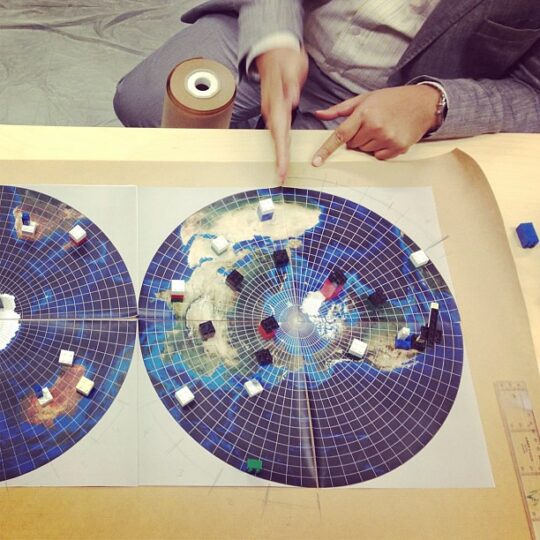
Yesterday (Thursday) I was joined by Karel to work on Galaxy Tours, the game heretofore codenamed Iruka that we’re making for Noordhoff about astronomy. It’s a team-based boardgame that can be used in the classroom to substitute for a traditional lecture. We’re nearing the finish line on this one, just a few final game design issues resulting from a playtest that need to be taken care of, plus some polish on the graphic design and we can deliver it to the client.
I also met with the Universiteitsmuseum (the Utrecht University’s local science museum) to discuss planning of Saba, a game we’re making for families visiting the museum. The project team for this, consisting of Karel, Hanne and Alper, will kick off next week. I’ve also interviewed a possible candidate for production assistance on this project, as I could use some help with planning, monitoring and logistics.
Today I was planning to work with Tim on Hamachi (a party game we’ll self-publish), but he has fallen ill so we’re postponing that for the moment.
In stead, I will make use of the extra time to put some more thought in my Noorderslag talk.
First of all, if you’re reading this, may 2012 bring peace, happiness and good fortune for you and your loved ones.
I have a number of talks both short and long lined up for the first few months of this year. Let me run them down for you:
I’ll present a talk titled ‘The Game Has Changed’ — about the role of play in society and its meaning for creative disciplines — at Eurosonic Noorderslag.
And finally, I’m honored to be speaking at LIFT12 as part of the session on ‘The New Face of Gaming’ alongside Hide & Seek’s Tom Armitage.
Somewhere in between all this, myself and a remarkable group of individuals I am lucky enough to collaborate with on a regular basis will head to Berlin to participate in the Global Game Jam.
It’s almost time to close shop for the holidays so I thought I’d do a final post. Here’s a month-by-month look back at some of the major things that happened at Hubbub in 2011 with links to relevant posts and such in case you missed it the first time around.
January – We start development on Code 4, a game for organizational change commissioned by the Dutch Tax Administration. It is codenamed Maguro.
February – I head to Cognitive Cities in Berlin which turns out to be an excellent experience. I stay in a Kreuzkölln apartment with Alper and Alexander and manage to take in quite a bit of what makes this city so appealing.
April – We finish work on Code 4 after a successful pilot run and deliver it to the client. By this time Niels has written a lovelytriptychof blog posts on what it feels like to work on the game.
June – A three-week tour of Japan makes for the perfect break from work and also provides me with a massive jolt of inspiration, culinary and otherwise.
July – Summer in the Netherlands means not much of anything gets done.
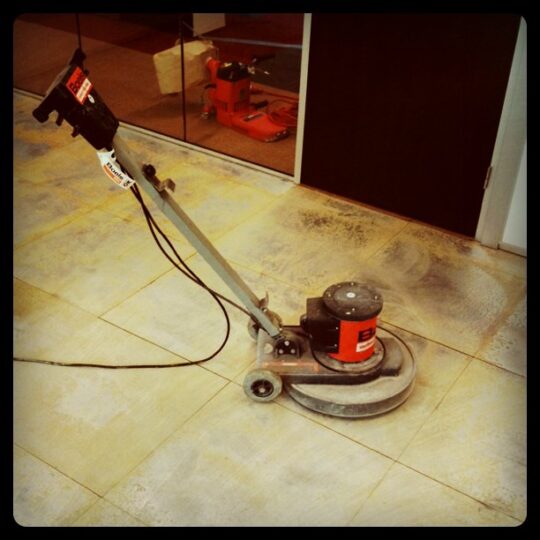
August – We bid FourceLabs, who we’ve been sharing a studio with since July 2010, farewell and move to a space of our own in the Dutch Game Garden. This involves replacing the floor, which turns out to be more of a challenge than anticipated.
September – A new project for Noordhoff codenamed Iruka starts. I also present The Transformers at dConstruct, and talk about both Pig Chase and Code 4 at the DiGRA conference Think Design Play.
October – Work continues on Iruka, punctuated by attending Playful in London which does not fail to please (and I don’t just say that because they put me in the site header).
November – We playtest Iruka and we start work on a promotional video for Code 4 (which at the moment of writing is nearing completion).
December – We have a party to celebrate the new studio. The concept video for Pig Chase is published.
Iruka and the Code 4 promotional video will bleed over into the new year. We’re also getting ready to start work on Saba, a game for a local museum. Other than that there are tons of plans for the next year, so I look forward to it with much excitement. Which leaves me with saying thanks for reading, I hope you’ll keep following us in 2012 and happy holidays!
For a while now, I’ve been part of a research project at the Utrecht School of the Arts, called Playing with Pigs. Up till now, I’ve referred to it as project Buta on this blog. We’re researching the weird relationship humans have with domesticated pigs. You know, pigs that are farmed for meat. The way we are researching this relationship is by designing a game. It is called Pig Chase.
Today I’m excited to be able to share the video sketch we made as a first step towards this game.
We’re making a game for several reasons. On the one hand, it allows you to experience questions related to the subject of pig farming first hand. Questions such as: are pigs intelligent animals? Is farming pigs for meat cruel? And so on. The other thing a game can do is transform how you relate to pigs. We’re exploring a new relationship, one that takes elements from how we deal with animals in the farm, the circus and the home.
The video sketch of Pig Chase is our way of putting the design of the game out there, to see how the world at large responds to it.
The choice for light as a medium is the result of a systematic exploration of what kinds of stimuli pigs respond to. We were aware of some evidence indicating pigs enjoy light. But when we saw how they reacted to a laser pointer, we knew we were on to something.
In case you’re wondering: yes, the plan is to actually build this thing. That’s the next step.
I’m looking forward to exploring the forms of play this system affords. I’m also keen on experimenting more with the idea of a symmetrical play space, and forms of play that are actually cognitively challenging to pigs. On the human side I am mostly fascinated by intimacy with an animal that is actually quite remote.
Finally, I’d like to highlight the amazing work done by my collaborators: Irene van Peer, who has been my sounding board on interaction design from the start, and whose expertise on everything ranging from participatory design methods to materials and construction has been indispensable. And Hein Lagerweij, whose broad range of video production and motion graphics skills have made this whole thing come to life in an amazing way. I’d also like to thank Clemens Driessen for his perspective on the ethics around technology and livestock farming, and Marinka Copier for her trust and vision.
It was at DiGRA that I first heard Eric Zimmerman talk about the idea of this being a ludic age. We’re in the period that follows the information age, which we’ve more or less left behind. In the ludic age, says Zimmerman, “information itself is put at play”.1
What does that mean? It can’t just be that it means we’ll get more games, and more kinds of games. That can be part of it, but there must be more to it.
I think hackatons are part of this idea of information put at play. A short while ago, I attended what was probably the most ambitious open data hack day of the Netherlands thus far.2Code Camping Amsterdam was host to almost 200 designers, technologists and civil servants who spent a day building useful or otherwise interesting hacks with newly opened up government data.3
Together with Chris Eidhof, I messed with a neat collection of old colonial maps. We made an attempt at unorthodox, playful displays of the maps, highlighting their visual richness. But we were thwarted by some less-than-optimal metadata. We did finish a prototype though, which shows a treemap of all the maps per half century.4
The opening screen of the app, showing a treemap
Although we did not manage to pull off a gorgeous Bloom-like data toy, or a playful tool for understanding like the ones Bret Victor has been writing about, I still feel us hacking away at maps is an example of activity in the ludic age.
For starters, we spent a Saturday, for fun, attempting to make something that presents a government data resource in an interesting way to the general public. That is not an information age activity, we weren’t doing this for profit, we weren’t even doing it as part of some kind of civil action, we were doing it for the fun of it.
Our means of arriving at the app were playful. We weren’t working according to some industry-standard methodology. We were flying by the seat of our pants. I would never work like that in a regular Hubbub project.5
Chris Eidhof and myself at Code Camping Amsterdam. Photo by Jean-Pierre Jans.
Finally, this was a collaboration, but between two people who had never made anything together before. For something like that to work, for Chris and myself to work well together, I think we had to arrive at something very much akin to Bernie DeKoven’s well-played game. We were hacking together because we both wanted to. We were playing (hacking) hard, taking it very seriously, while at the same time aware of the not-seriousness of it all. We could fail, it would be OK. And we were mindful of each other’s agendas. Of what each of us wanted out of the game (that hack day).
So on many levels, even if the product ultimately isn’t incredibly playful, just a humble iPad app (with some very pretty maps) our means of arriving at it were a fine example of ludic practice in the post-digital age.
There are moments in a design process where you more or less do, of course, that’s part of invention, but there’s equal parts structure, normally. [↩]
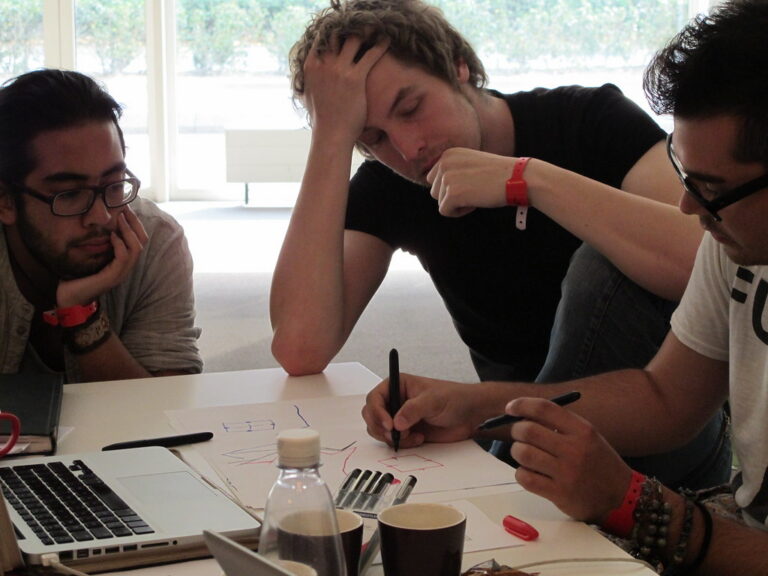
Over the years, I’ve run a variety of game design workshops, both standalone and as part of larger events.1 They’re typically aimed at creating simple, analog games that can be played inside or on the streets.
I enjoy doing workshops because I get to see how others deal with the unique challenges of designing physical games. Things like recruiting players to an ongoing game, or considering the role bystanders. I learn something from both the successes and the failures of participants. It’s also a challenge to create a workshop program with just the right amount of guidance (not too much, not too little, much like finding the right balance of rules in game design).
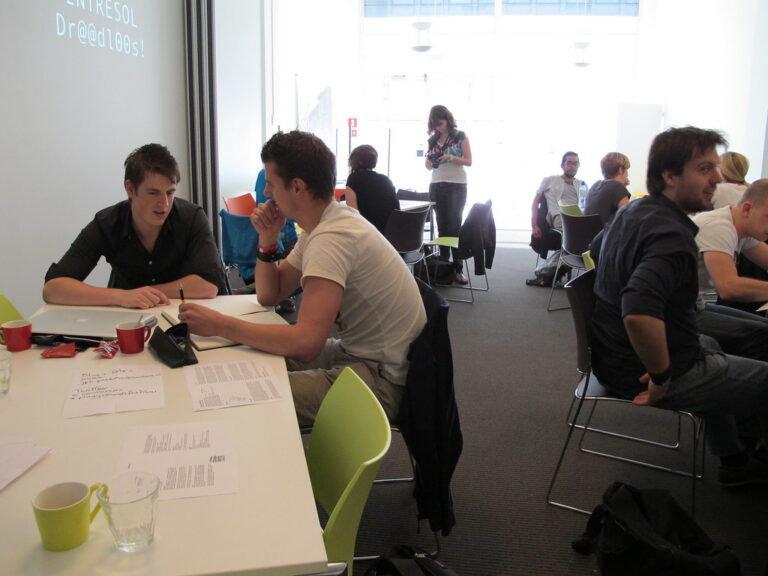
The most recent workshop we ran took place in the days before Playgrounds Festival. There were several on offer to students of art schools from the region. Other workshop facilitators included Vlambeer and PIPS:lab.
The workshop was about designing games for the main conference, which would take place later that week. So the audience was conference-goers, always a tough crowd to get involved into a game. They’re usually too busy running from session to session and chatting in the hallways. It turned out this also applied to this conference, even though it was called Playgrounds. (It’s about motion graphics, animation, that sort of stuff, mostly.)
The brief allowed for a variety of forms, such as street games, conference games and party games. We also allowed participants to choose their own location in and around the conference venue.
We had three days, and divided it up in equal parts: introduction to the field & ideation, prototyping & design and finally testing & evaluation.
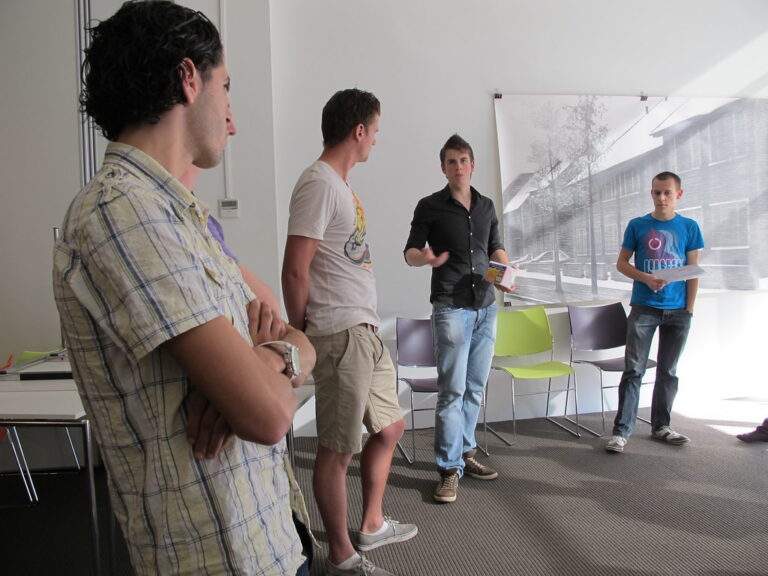
An impression of what was made
I was really happy to see the variety of games that emerged. I had collected a bunch of example games to get the participants started: Mafia, Cruel 2B Kind, Capture the Flag, Prui and James Wallis’s GameCamp minifig game. We also played a game of Ninja Tag to warm up. I’d like to think this underlined the idea that there are many ways to create interesting play experiences.
In order of appearance the video shows a Tron light-cycles inspired game where you try to surround your opponent, a tagging game, a game about hunting foxes, a paint-with-your feet game, and a drawing game using markers tied to cycling helmets. Like I said, a nice range of games offering quite different kinds of play.
Some observations
Concepts that rely on spontaneous audience participation have an immediate disadvantage. In particular when the act to be performed is slightly theatrical and/or silly. Best to have a sign-up booth and have players come to you. You don’t want to put people on the spot, much less in front of their friends. Play is voluntary after all. You can and probably should go out and do promotion for your game and draw people to your booth. When promoting your game it is very important to have a clear and short description of the game experience you’re offering.
A common pitfall in the design of physical games is that the activity created is evaluated on how amusing it is to observe, in stead of how interesting it is to do. There’s a difference between what a US or UK audience and a Dutch audience are willing to engage in. Within those national groups there are again massive differences from subculture to subculture. This is an issue because the current state of the art is mostly influenced by creators from the Anglo-sphere.
Playtesting highlighted these issues for many of the games and as such it was a massive learning experience. It takes courage to put your game out there at a conference, to ask a complete stranger to have a go. I admire the participants for having the guts to do this, even if not all games were as successful at drawing in players.
Where to go next
I have the feeling that the street gaming scene has become somewhat conservative. So I would like for future workshops to push at its boundaries. This means setting new briefs, perhaps more focused briefs, ones that deliberately break with current street gaming form. One idea that has been on my mind for some time is to look at toys, and focus less on rules design. This is inspired in part by Doug Wilson’s work on Johann Sebastian Joust, and projects like Ringg, which came out of the Utrecht School of the Arts. A workshop about rules-light, open-ended tools for play. You’re welcome to steal this idea for your own workshop, or invite me to come and run it at one of your events. Either way, I’d be happy to hear from you.
I should thank Sarah Lugthart and Leon van Rooij for inviting me to their festival, and all the workshop participants for their enthusiastic involvement. In addition I should point out the significant contribution to this particular workshop by occasional agent of Hubbub Arjen de Jong.
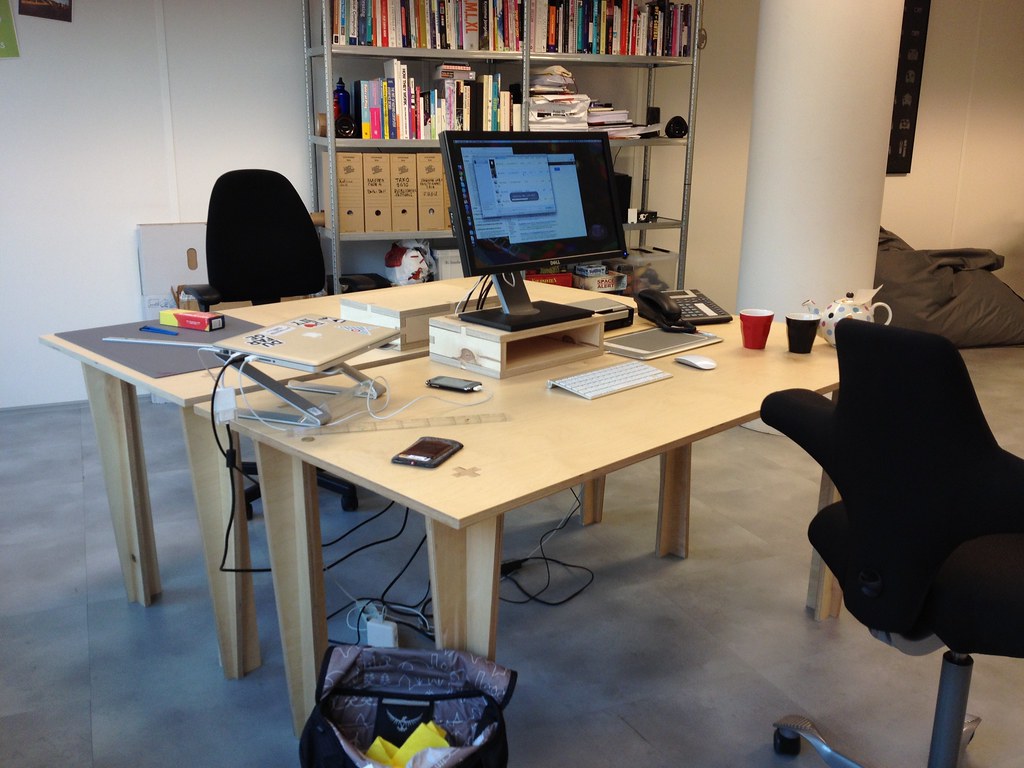
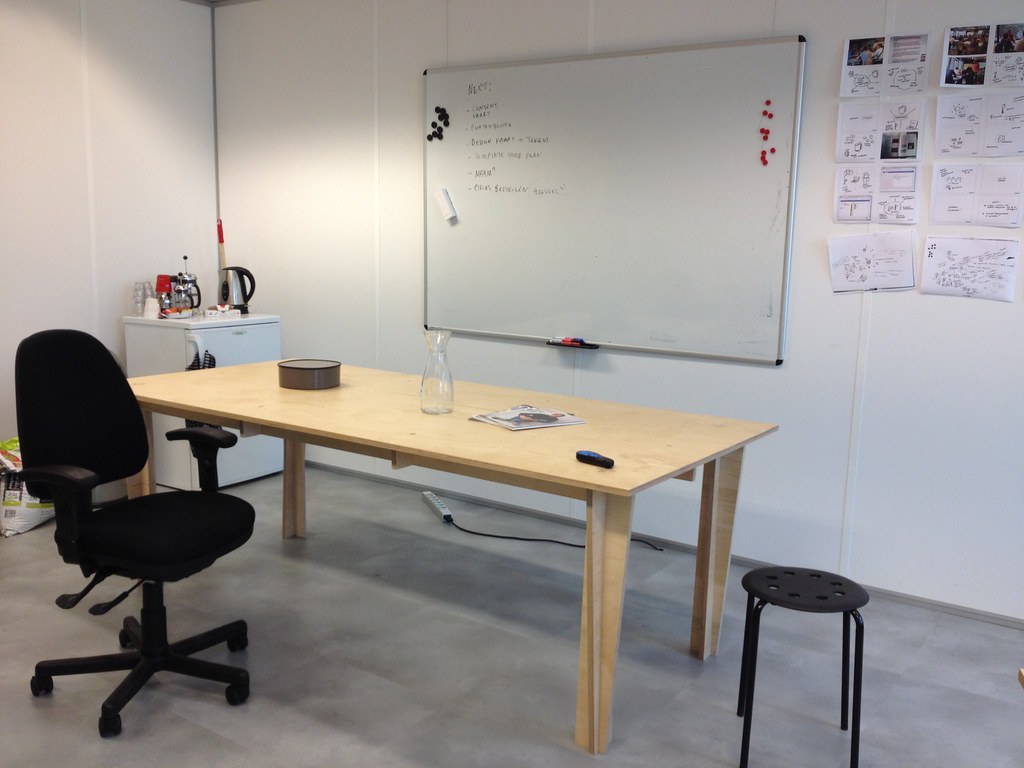
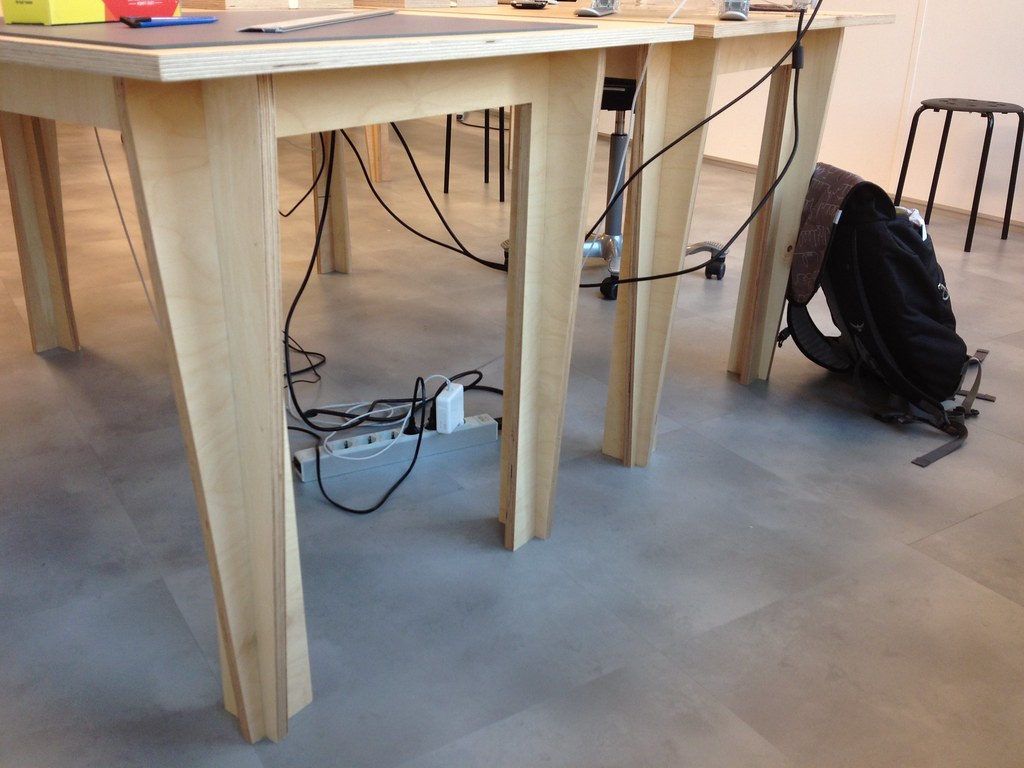
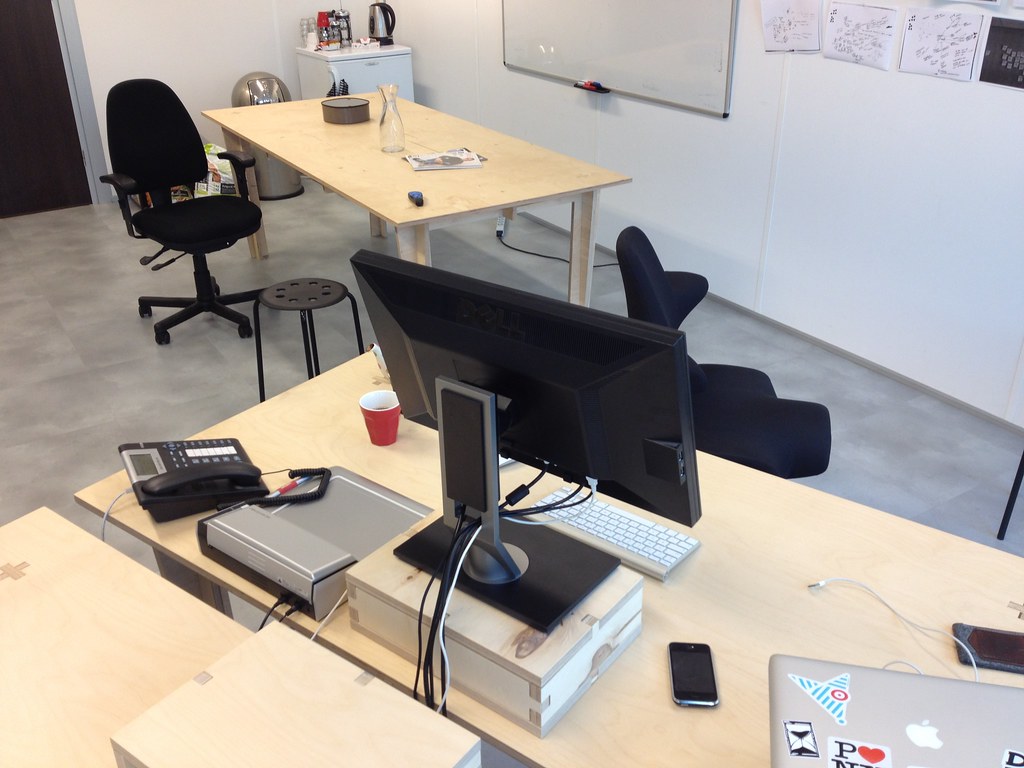
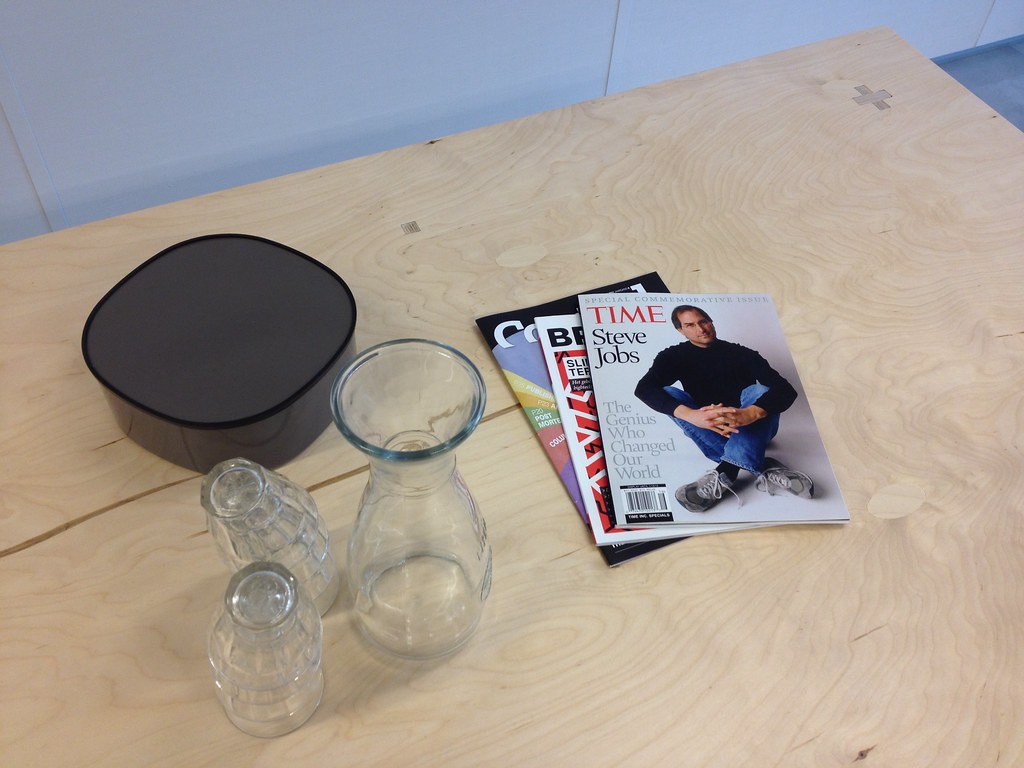
I’m writing this from behind a new desk. These were designed by my brother Ties. He’d done a pair of desks for BUROPONY before and when I saw his new design for a meeting table I asked him to also make a smaller version that could be used as a desk.
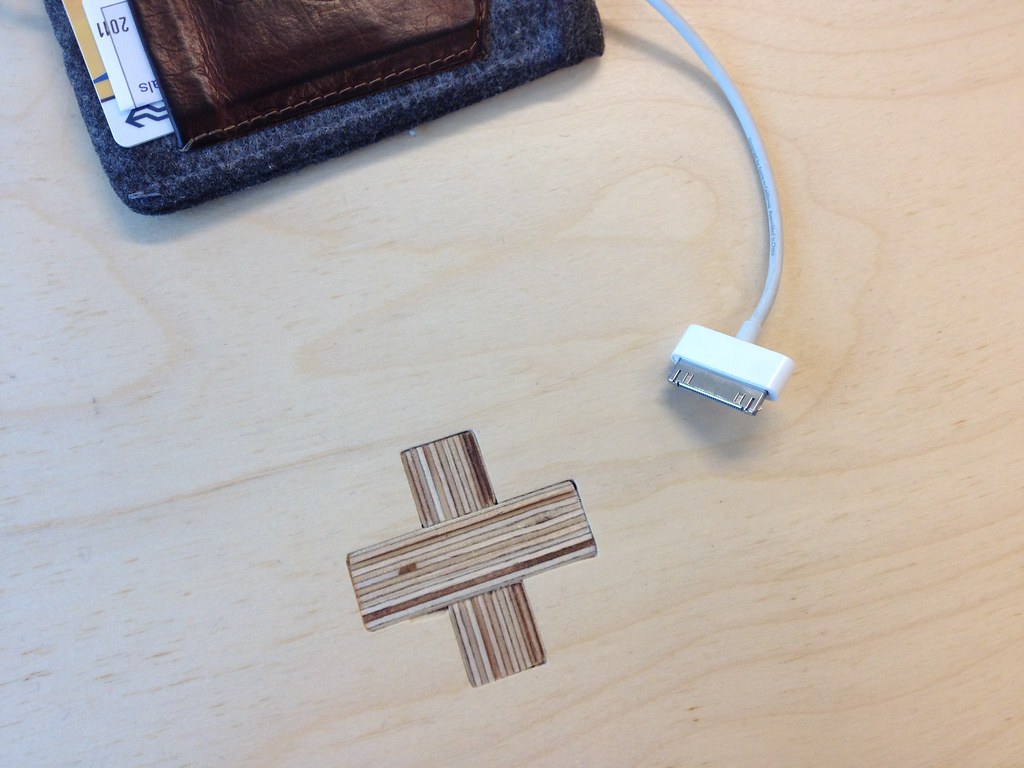
The design is reminiscent of those wooden dinosaur skeletons. All the parts are milled from birch wood plates and slide into place without the need for glue, nails or screws.
We did have to sand them down and lacquer them, though. That was a bit more work than I had expected… (Good thing I had help from my brother and sister.)
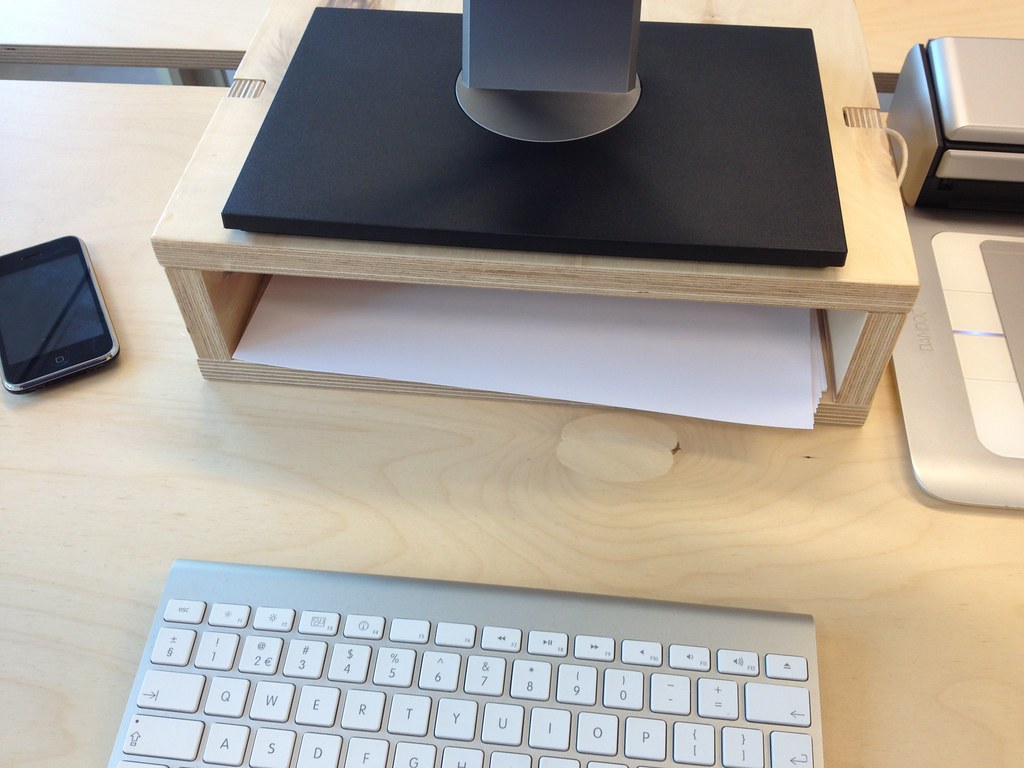
There was a bit of space left on some of the plates, so we also made monitor stands that can hold a stack of A4 sized paper.
I think they look really neat and I can tell you they’re a pleasure to work from. I love the natural unfinished look, and the feel of the wood grain. Here’s a few more shots.
Desks (photo: Kars Alfrink)
Meeting table (photo: Kars Alfrink)
Legs (photo: Kars Alfrink)
Overview (photo: Kars Alfrink)
Monitor stand (photo: Kars Alfrink)
Joinery (photo: Kars Alfrink)
Surface (photo: Kars Alfrink)
Photos by Kars Alfrink, from the Flickr album New tables.
We’ve been talking about Code 4 at various venues the past few months. So I thought I should collect the results from those events here, in case you’ve missed them the first time around.
Code 4 is the large-scale game for organizational game we made for the Dutch Tax Administration in collaboration with Demovides and the Utrecht School of the Arts. It uses various media to propel players into a game set in the near future, which is interwoven with their daily work. Broadly speaking, the aim was to improve participant’s skills in terms of organizational capacity and client-centeredness..
Read DiGRA practice paper
In September, I presented a practice paper on the game at the DiGRA 2011 Conference: Think Design Play. It’s in the conference proceedings but I’ve uploaded a PDF to this site as well for your reading pleasure.
Watch the Chi Sparks talk
Agent in charge of all things software Alper Çugun spent a high-paced 10 minutes talking about the game and its creation process at Chi Sparks in June. Below is a video of that talk:
And of course, a full project write-up is in the portfolio. As mentioned before, we’re working on a video illustrating the player experience. So stay tuned for more on that.
After making the many different creative industries out there take games seriously (and subsequently sort of regretting the consequences) Playful was back this year and decided to look towards the future. Ever since I presented there in 2008 this has probably been my favorite event of the year. So I returned after a much-regretted hiatus to attend Playful 2011 — the shape of things to come.
Longing for a Death Star
Conference director Toby Barnes kicked off the day bemoaning the fact that there was still no Death Star floating somewhere in space. He longed for a return of ambitious future thinking as opposed to the more mundane, close-to-home, near future foresight that seems to be in vogue. The “where’s my jetpack” argument, basically. But Toby qualified this further by adding he was longing for more folk wanting to make “a dent in the universe” because, as was implied, that is what these times call for.
Escaping the prison of imagination
He was later scolded by Marcus Brown, being accused of living in the “middle aged future” a neat term he coined to describe the fact that current innovations are shaped by the ideas imprinted on our collective unconscious by science fiction of the 70s and 80s, best exemplified by the uncanny resemblance of Siri to HAL-9000.
What I found most fascinating about Brown’s talk, but sadly had to be rushed due to time constraints, were three far-future worlds he sketched and subsequently challenged the audience to imagine living in. “The Billion Dollar Show”, for instance, is a world post peak-oil, where we have to make do without any fossil fuels. It’s not a distopia, but something akin to a real-life FarmVille.
Science fiction, as Al Robertson pointed out earlier in the day, has constructive playfulness at its core. What I think Marcus Brown was attempting to do was get us thinking beyond what we know, and force our minds into the unknown, and to get playfully creative with the possibilities. To break out of the future scenarios we know from the sci-fi that have aged and — let’s face it — haven’t aged well.
Making things that dent
However, there is something in Toby Barnes’s call for “making a dent”, but I think it needs to be coupled with Marcus Brown’s demand to break out of the “prison for kids with too much imagination”. And in fact, during the day, some of the talks I enjoyed the most were great examples of constructive playfulness attempting to make a dent — however small — in culture.
Brendan Dawes sung the praises of devices such as the MakerBot, and emphasized the need for each of us to have a “shed” in which to experiment and tinker (even if the thing you call a hacker space is actually just the back room). The fact that this can lead to interesting new products is exemplified by Popa, “a big red button for your iPhone camera”. Which arguably would not be possible without the futurey technologies at our disposal today, such as desktop fabrication.
The Vimeo video that was embedded here has been removed.
Both Chris O’Shea and Toca Boca called for more open-ended play in iPhone games for kids — something which I think can be directly traced to Playful’s evangelism over the past years. Chris shared work-in-progress on a digital race car toy, which included experiments with physical iPhone cases that kids could build themselves. Toca Boca impressed us with a large number of digital toys for imaginative play produced in under a year, with my personal favorite being Toca Hair Salon. Who doesn’t want to groom a lion?
Finally, Matthew Ward amazed me with Green=Boom, an installation allowing you to experience the thrill of disarming a bomb, something we’ve seen a zillion times in action movies but have probably never done ourselves. The bomb in this case is a balloon which is popped if you cut the wrong wire. It’s amazing to see how our bodies respond to a seemingly harmless setup like this with high levels of distress. Apparently decades of seeing others go through the ordeal on the silver screen has conditioned us in a big way.
The Vimeo video that was embedded here has been removed.
To summarize, what I took away from Playful is that making things is still the best way to complain, wether it’s consumer electronics’s shift to touchscreens, the competitive nature of entertainment software for kids, or the consumption of violent imagery in mainstream media, the future we find ourselves living in today enables individuals to make real, tangible interventions with very little time and means required. Consumer culture has become a playground for makers.
Update, October 24, 2011: added section headers and a few more links.






Starting up in Berlin
Our agent Alper has recently moved to Berlin to establish a presence over there and he will be reporting on his progress from time to time.
For reasons both personal and professional I have relocated to Berlin to start afresh in that great Athens on the Spree. Berlin is seeing a resurgence of digital/creative activity that is garnering quite a lot of attention not to mention speculation. Let the reasons for that be what they are, what matters to us is that it is a proper metropolis with both opportunity and urgency for playful experiences.
Having just arrived, the help of (friends of) friends1 has been invaluable to get started quickly. The temporary office space, knowledge of the local bureaucracies and the connections made, that would otherwise have taken months of attending meetups in shady bars, have all been invaluable. I am surprised how seamless the transition from a city in one country to another can be with our professional communications and culture homogenized by the internet.
Picture by Edial Dekker
Last week, my first week in Berlin in earnest, has been focused on looking for office space and getting some work done that had been left because of the move and the holidays. The start of the week I spent doing a thorough traversal of Berlin’s coworking spaces2 and these last couple of days have been more productive working at the center of most things digital here, the Betahaus.
Setting up shop for Hubbub as well as my other professional affiliations, I’m looking for a shared studio3 to go to every morning, where I can have a desk and where I can put my screen and books. This place would be preferably located somewhere in or near Kreuzberg. I have some promising leads, but if you can add to those, do get in touch.
In time we are planning to expand into a location where a handful of people can work on projects in a comfortable fashion. The Berlin studio will always remain tightly connected to the Utrecht mothership, but it should be able to operate autonomously in the same loose fashion that most of our collaboration takes place. A colony on another planet, if you will, though right now Berlin is a bit more hospitable than Mars.
With regard to connections, I have met up with the local indie game developers during a previous visit and Hubbub will be out in force for the Global Game Jam Berlin at the end of this month. Even though I am a debutant in that particular format, we hope to present a respectable showing with the help of some more experienced team members. I am particularly interested in meeting people busy with games for social/organizational change in Germany and comparing notes with what works and what doesn’t. But if you are otherwise interested in playful experiences to get people to engage and create I would of course also love to get in touch4.