Lots of logistics this week and new projects getting started. I was due to be back in the Netherlands for some meetings so I started Monday in Utrecht at Hubbub HQ while Kars went to Info.nl to work on ASARI1. We’re really happy to be working together with our old friends over in Amsterdam and we think we have found a way that suits both of our skills very well.
I was finishing preparation for SAME for which I flew out to Munich at the end of the afternoon. Which meant I missed This Happened Utrecht #16 and dinner with that set. Kars says that the story behind the Philips Hue lamps skunk works was the best one.
We worked on the new version of Beestenbende throughout this week, coming up with a detailed redesign and going through that with the Universiteitsmuseum. Kars talked a bit with our friends over at the GEElab in Karlsruhe while I spent the day in Munich facilitating a workshop together with Sebastian.
I flew back that same night and spent Wednesday and Thursday at Hubbub going over our plans for the next year with Kars using the OKR framework by Google which is proving to be just measurable enough for our taste. We input all of that in our Asana and we’re good to go for the rest of 2013.
Kars ended the week with impromptu drinks with Sander and bits of Vlambeer and Monobanda while I spent Friday making the rounds of Amsterdam and visiting our friends over at Bruns&Niks and Hackers and Founders:
Which happens to be written like this: アサリ. I’m learning Japanese and having a lot of fun with the various ways to write our codenames. [↩]
These notes cover the past two weeks. Week 199 covered the tail end of my honeymoon on Bali. Spending time on the island was a pleasure as always. (I’ve lost count, but I think this was my sixth visit.) My absence combined with a temporary lull in client work gave Alper the opportunity to relax a little and spend some time on side projects, such as Cuppings.
I returned to work in week 200, but was a bit handicapped by a rather persistent flu. Nonetheless, I got some work done. To start, I caught up with Alper on current affairs and trawled through an email backlog of two weeks.
Then, I started work on the redesign of Beestenbende. Revisiting old design problems that confounded us when we last worked on them almost a year ago, I suddenly found some new solutions that now look so obvious. There’s probably a lesson in there somewhere.
I played Alper’s personal slide designer, tweaking the deck of his MLOVE talk on the social issues involved with the quantified self movement.
And I finished the week designing my tiny game for Hide&Seek’s wonderful upcoming app. You’d think with Victory Boogie Woogie at an end I would have had enough of collaborative storytelling games, but I came up with another one. In this case it’s for two players and requires an old fashioned paper novel as a play aid. I had fun playtesting it over the weekend so we’re on the right track.
Alper tells me he started the week doing a bit of work on Victory Boogie Woogie (moving the site into its post-game stage).
He also prepped his MLOVE talk, as mentioned earlier, and delivered it on Thursday. It was titled “The Quantified Good Life”. I believe things went well, in particular the Q&A afterwards alongside fellow Dutchmen Yuri van Geest and Maarten den Braber. The drive back from the event’s venue, a castle outside of Berlin, took Alper 10 hours, due to terrible weather and resulting traffic. I’m glad he made it back in one piece.
The rest of the week was mainly taken up by SAME, a consultancy gig for our second German client (an automobile manufacturer) for which we’ve partnered up with studio friend Sebastian Deterding. The first workshop for this is due to take place this week. Alper will be on site together with Sebastian (it’s a German language affair) I’ll be standby in Utrecht.
Last week was a slow one but I’m getting things in order for when Kars gets back. Rounding up a bunch of stuff and closing new consulting work that we will be working on over the summer.
I also discussed my participation on a quantified self track at MLOVE where I’ll be talking about the ethics and possibilities of measuring yourself. As far as I am concerned the quantified self movement contains within it many of the same possibilities and also many of the same problems that gamification struggles with.
I went to the local DIYbio group at the Raumfahrtagentur to explore the possibilities of biotechnology and game design. The various spaces in that part of Wedding are very nice even if only to relax at, but the group already has a fairly outfitted laboratory which is continuously being expanded:
A brief week for us this past one, I travelled to Utrecht to do some work at headquarters, give a talk and most importantly for Kars’s marriage. Kars’s week was a bit shorter than usual for the same reasons and while I am writing this he should be on a tropical island.
The studio will be humming along but with production on some projects having concluded and others just now in the post-signing phase, there is a small lull. The perfect time to get around to the other stuff that had been neglected.
Kars got married that same Friday and he took with him on his honeymoon an old concept as a prototype, ‘strictly to unwind with at the beach’ he assured me.
Last week, Alper spent time leading development on Victory Boogie Woogie and Ripple Effect while I lead the design.
For the former, we worked on the final update which should considerably improve the homepage. It’s always a challenge to design ahead of actual content. Now that the game has been running for some time we have much more material to work from.
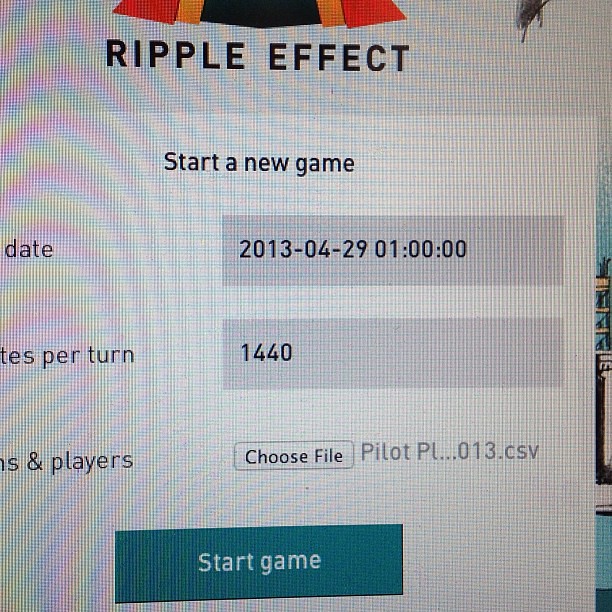
For the latter, we’ve been processing the pilot’s results and wrapping up things for further development later on. One of the things I particularly enjoyed doing was to make a quick video for our client demoing a new physical prototype created by Tim, which demonstrates solutions to some of the issues encountered during the pilot.
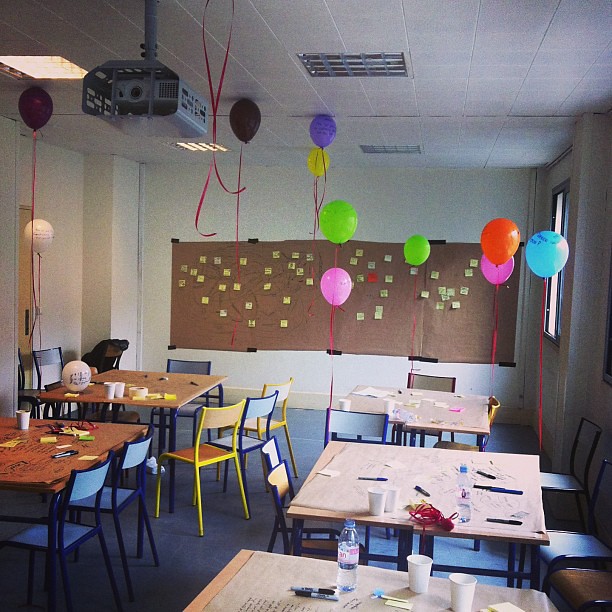
I also facilitated a workshop at a Dutch broadcaster together with Jeroen van Mastrigt of We Love Your Work. The workshop focused on adapting a game concept—which takes as its input clips from TV—to a new show. In the process we introduced some new mechanics that were thematically appropriate to the show’s content. It was a very focused, very productive workshop with immediately actionable items as the outcome.
In between all this there was also time for cake with our friends at Game Oven to celebrate the launch of their latest game Bam Fu, which you should totally go out and play.
Last week we were busy evaluating KAIGARA post-pilot information and sketching out a course to develop the final game. We received tons of player input, client input and we came up with a bunch of ideas of our own to improve the game. We’re right now busy agreeing on a coherent plan from that set that best accomplishes all of the goals for the game. The KAIGARA team got reinforced with the production skills of Dylan Nagel. Dylan got off to a solid start by schooling Kars on SCRUM best practices.
Besides doing our in-house production work, we have a parallel pipeline of consulting. FURAPPA has just wrapped up and we’re busy ramping up the following engagements (with startups and in Dutch broadcasting). Consulting is refreshingly different from what we normally do. We don’t have the luxury to be present at all stages of development, but that also gives us the freedom and creative license to focus solely on the concept and deliver interestingness. And if need be we can always back up these concepts with game design, prototypes and full development.
Kars was also present at What Design Can Do last week to participate in a closed session on social design. The session was taped and will be published (quickly, I hope).
Last week was mostly us quietly working away on our current projects, with some extracuricular activities in between. Here’s what happened:
Victory Boogie Woogie (SAKE)
We shipped some new features to Victory Boogie Woogie, most notably a swanky preview mode for players and writers and limited markup capabilities for the latter. Not exactly rocket science but something that warrants careful testing and tuning nonetheless. I’m particularly pleased with the automagic prettification of typography we’ve added with help from typogrify.
Meanwhile VBW is humming along nicely and we’re getting wonderful player submissions which really challenge the writers team’s creativity. Once again it was a pleasure for me join in on the weekly writers meeting on Friday and hear them talk about what had happened and how they plan to respond to it.
This was the second week of the Ripple Effect pilot so we were following player activity closely behind the scenes. Intercom is proving an incredibly handy tool for us to keep in touch with our player base, which is spread across the globe.
Meanwhile we continued to make plans for the second version based on the feedback we’d gotten so far. This included playing through a new physical prototype put together by Tim. Poking and prodding, tweaking and tuning, that sort of thing.
Development also started on extra features which will be needed to allow the game to be rolled out decentrally and scale to a large global audience. These are mostly peripheral to the actual game but important nonetheless.
KANT
Also this week, Alper moved his workplace from Praxis to KANT. Also on Oranienstraße, but with a different crowd in attendance, this looks like a ‘lab’ very much in tune with our own outlook.
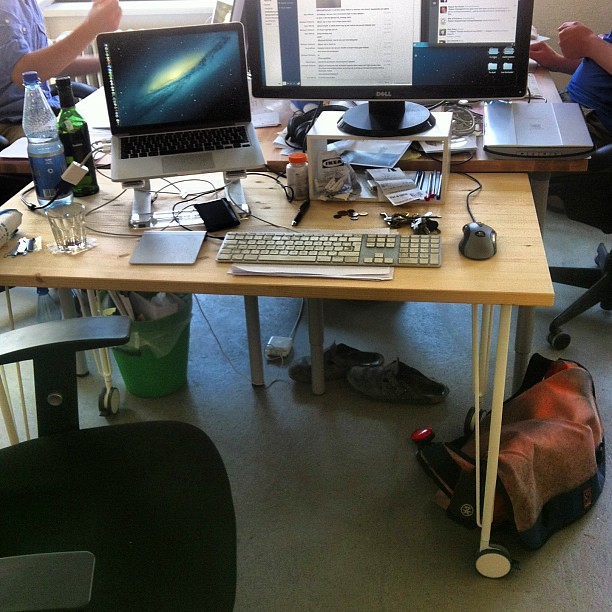
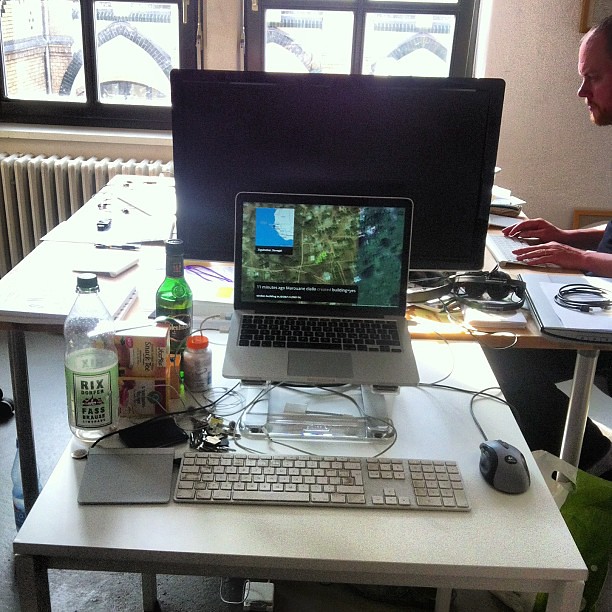
Alper’s temporary desk at KANT. I hope they get him a bigger one soon.
Miscellanea
On Monday, I joined in on Hans de Zwart’s Understanding Media reading group and shared my thoughts on McLuhan’s perspective on games. I’m told it was recorded so look for that shortly. Update: Hans has shared the recording with us.
On Tuesday, I was interviewed about stories in applied games together with Niels ‘t Hooft at Control Gamelab. The video is up already, note that it’s in Dutch though.
On Thursday I finally got around to writing another Recess! in which I throw down the gauntlet and attempt to provoke Niels and Alper into some critical reflection on their own preferences in game playing and making.
Bring on week 195!
Niels and Kars on an inflatable couch at Control Gamelab #8.
Last week while I was still in Paris (like Kars mentioned in the previous week’s notes) we launched the pilot for Ripple Effect. That was a moment where we saw the work of the past period come to fruition and exposed real players worldwide to the game. The game has held up very nicely but we are also learning a lot that we can improve which is exactly what a pilot is for.
I spent the day in Paris working at La Cantine, a solid testament to how portable our work infrastructure has become:
Victory Boogie Woogie is seeing a steady tricle of writing and we’re planning to push out some more updates on that.
On Wednesday night, the day before UIKonf in Berlin, there were a set of lightning talks where I went and presented Beestenbende from a mobile game design perspective. I had given a brief presentation previously on the technical aspects, but I think the most interesting part is how we got people to play a fun game in a museum.
Arjen published his massive missive on the lessons he brought back with him from this year’s Knutepunkt. If you haven’t read that yet, it is well worth checking out.
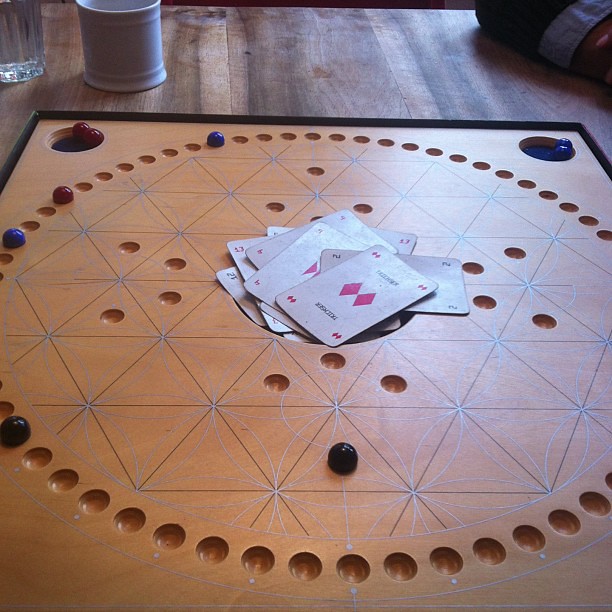
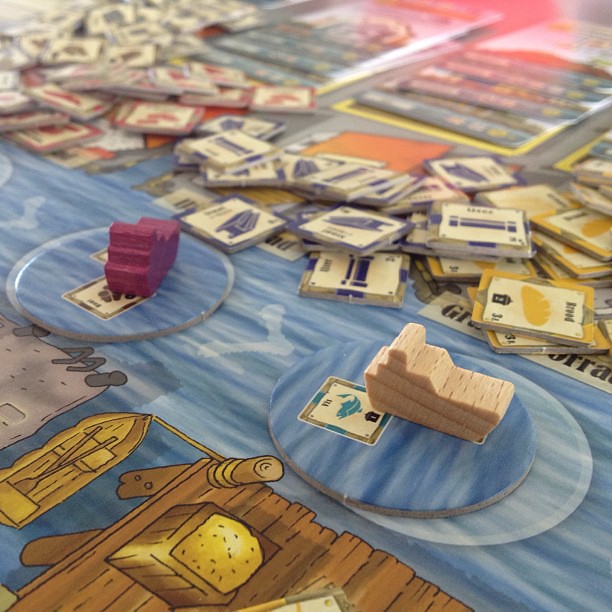
And also Kars played a bit of Le Havre which is a nice and complicated eurogame and I played Grit the dueling card game by Zach Gage:
Recently I traveled to Norway. Not because they still had snow there, but because Knutepunkt 2013 was in the land of lakes, fjords and good fish. Knutepunkt is an event that is hosted every year in a different Nordic country and serves as a get-together for the Nordic larp scene, full of talks, workshops, discussions and meeting people. To show what has been made in the field last year, and to discuss what should be next.
One of the views over the majestic frozen lake at the venue.
This Knutepunkt was all about “crossing borders”, both in terms of countries and design scenes. About reaching out and sharing the knowledge. So I went to see what Knutepunkt could teach me, you, and everyone out there. I will summarize it for all of you, from larpers to art lovers, from game designers to executives. Read your personalized takeaway from Knutepunkt 2013 below.
About Nordic larp
For those of you not familiar with the term larp, it describes a genre of roleplaying games where players enact their character and actions in the physical space rather than telling other players what they are doing or using metaphors like dice or a digitally controlled avatar to do so. In a way players ‘become’ the character they role-play, because of the physical nature of most games and elements that improve immersion like costumes, scenery or entire in-game venues. This very short explanation generalizes the diversity of the genre a bit, so if you’d like to know more, Wikipedia would be a good place to start for a more thorough description.
The term Nordic larp is then used to describe the larp scene present in Denmark, Norway, Sweden and Finland, which has grown most notably in diversity over the past 20 years when compared to other larp scenes due to the active documentation of and discourse around the games made in these countries. This has resulted in a more varied scene in terms of the types of games being hosted in those countries1, some of which aim to create artistic games focusing heavily on dramatic interaction and meaningful experiences rather than making “just” a fun game. This in turn has widened the potential uses of larps in these countries, where they are now not only made for entertainment but also for education, social experiments, expressing artistic or political messages and much more. As such the Nordic larp scene is widely known as one of the most advanced larp scenes in terms of game design practice, documentation and research.
With the introduction out of the way, lets move on to my takeaways.
The non-Nordic larper
So you enjoy the occasional hitting of orcs with weaponized latex or maybe you might even be interested in some intensely dramatic games. There’s lots to be learned for all! First off, start by using these two words: game designer and larp writer. Because if we want to widen our expertise and improve our games, lets first properly recognize the people who make them. Once we’ve done that, let’s start thinking about and discussing the design of our games; document them, share them, improve upon them. I’m not saying our larps are necessarily inferior to Nordic larps, I’m saying that there is a lot to be won if we start actively thinking about the design of our games.
Many larp scenes out here often have a few solid formats copied over various events for years, with little to no variation at all. There are a lot of different types of games that we could make and host. There are lots of improvements to be made upon our existing formats if we look at our events as game designers rather than organizers. Think of encounter design, finding different approaches of presenting the plot to players, managing role-play standards in a community, creating costumes and other presentation methods, just to name a few of the things we can improve together. I’m calling upon fellow larp designers to be conscious of what it is we are creating and discuss the choices we make doing so.
Some small larps were also played during the conference.
And why do we make improving games so hard for ourselves? Why do we have to go to other events to know what they are experimenting with? Just writing a 500-word article saying ‘we hosted a larp in which we did A and it resulted in B’ can help push the scene forward. Only then can we reach out to other fields, become more than ‘those nerds with elf-ears in a forest’ to the outside world and showcase the hidden gems our scene may have. Because a bunch of photographs and heroic campfire stories are cool for those that actually visited the larp, but they keep the many people not included in that group groping in the dark.
The game designer
Role-play in games is more than a bunch of guys playing Dungeons & Dragons. As a matter of fact, as a game designer, roleplaying could be a valuable asset in your toolkit. Let players enact the character or role they take on in your game and reward them for doing so.2 To make them part of your game in such a way increases their immersion and allows you to tell the story of the game in a fashion that is more closely tied to the gameplay. This does not mean you have to necessarily make your game facilitate roleplaying for the the full 100%. Rather, use it as a tool when applicable. Design the function and place of the player in the narrative more actively, most notably in relation to other players, and give them freedom to role-play as much as your game can support.
The program at Knutepunkt offered talks, workshops, panels and small games. Audience participation was preferred, even at the talks.
Learn from the Scandinavians and use character design to tell your story, create a conflict or script an event. Character design is often one of the main aspects of creating a Nordic larp. Many of these larps facilitate the major part of their story or events through player-to-player interaction manipulated via the characters they are playing. With some insight, much of this is transferable to a lot of other game genres. Whether you assign players a character at the start of the game or slowly lead them on the path of becoming the character you have planned for them, players will be delighted to be such a strong part of the story. Forget handing the players information through non-player characters, activate a player by giving him special info before or during the game. Make them an active part of the events in your game instead of having them listen to (or read) monologue after monologue. Allow players to fill in key aspects of your story and they will become part of it and share it. And last but not least, always remember that the narrative of your game is what the player experiences, not what he reads or hears. And roleplaying is experiencing.
The gamer
What’s in it for you as a player of games, whatever the kind? Well, Knutepunkt’s mission to encourage clear discourse around the design of larps and to permeate borders of other design scenes with the obtained knowledge makes that these well-designed forms of roleplaying may be used in many more types of games soon. And why is roleplaying such a good thing for you, the player? Well, first of all, it increases your influence as a player in the game and on its content. Games that are designed to enable and reward roleplaying give the players more freedom in choosing their actions, and a stronger effect of those actions. It enables the player to become part of the game and even provide an experience for other players. Because, lets face it, you’ve always wanted to be the protagonist or antagonist in stories. There is something very satisfying about becoming part of another person’s experience, about having your actions live on in legend.
Secondly, Nordic larps are often the canvas for a far wider array of characters than most game scenes are used to. Don’t just play the hero who slays the dragon or the soldier who wins the war over and over again. Play the drug addict, the mother in a family of 8, the doctor on a federation starship, anything really. Discover new types of characters, different views on life, new experiences. Nordic larp has proven to excel at providing players with unlikely heroes and unusual experiences. Here’s to hoping game designers pick up on this.
The executive
Remember the last time your company hired some agency to give your employees a training with live actors? Good chance it wasn’t quite as effective as you’d hoped it would be. Next time, why not try to work with game designers that have learned from Knutepunkt? In the Nordic countries, larps are used for education, training, cultural engagement, or even as a tool for development. Last Knutepunkt, Norwegian minister of development Heikki Holmås even visited to give his thoughts on the matter.
Nordic larp techniques can be used to create a safe game environment for people to try out different approaches, rise above their usual thought patterns, or get out of their regular role and experience matters from another angle. Where normal trainings struggle to get people to move out of their comfort zone and actually start experimenting and learning, games provide players with permission and encouragement to do so. Roleplaying workshops before the game even starts, tried and tested strategies of design and profound knowledge of how groups of people function do the rest. And it’s just as much fun as it is beneficial.
The theatre designer
Theatre, I know you. I know how you struggle to engage with new audiences. How you work to break the fourth wall wide open and get your audience to participate in your plays. I’ve made my fair share of interactive theatre myself. I know how most people are scared to really participate. I know how hard it can be to make meaningful theatre while allowing the audience to have influence. Engaging your audience however is a bright and fascinating future for the performing arts, if done right.
Opening ceremony of the party on Saturday evening.
When I hear about some of the Nordic larps, they strongly remind me of how professional actors do roleplaying and improvisational scenes to train their acting or create material. Those larps get players to act like they never knew they could, to engage with the play that is presented.
So next time you try to tear down that fourth wall, remember to do it like they do it at Knutepunkt: give your players characters to enact. Build a safe environment and an illusory mask for them to hide behind and they will do almost anything. Engaging with the unknown as yourself is scary and you will feel looked upon. Engaging with it as a character someone told you to be is a lot less frightening. Send them on their way with a briefing beforehand, a workshop, or smart design of the play itself. No matter how you do it, give them their mask and they will take part in your adventure.
The art lover
There is something like community art, and then there is Nordic larp. Live up to any role. Experience any artistic message. Be part of the artwork itself. At Knutepunkt they show how art can be made through role-play, and how role-play can be art in itself. It’s all about setting the frameworks for a group of people to be let loose in. To experience different societies, imagined stories. Sure, an artist can show you how he would imagine a world without capitalism. Or he can let you live it. Every piece is here and now, always unique and unrepeatable, co-created and lived by its primary audience. They are still quite rare, but if you ever come across a Nordic-inspired art larp, dive in!
The opening ceremony on Thursday.
The designer who already does all of this
Then why don’t we know? The last message of Knutepunkt is to share. Document for yourself and others. Become better in designing as a community. The Nordic larp hasn’t evolved this far by pure chance. It’s done so because of the community behind it, getting together to discuss design, tackle recent issues, reflect on what has been made and become wiser. And that is a message that can be given as an advice to any new scene out there: Get together. Establish a discourse. Share cool projects. Make even more awesome projects.
The ending ceremony on Sunday.
And for me?
Knutepunkt has been a big inspiration. I have met awesome people from various countries, and learned much from the Nordic way of designing larps. It wasn’t all new material, but hearing about things you have been dealing with or thinking about from others in a clear and organized fashion helps the thought process a great deal. Plans I had for alternative larps in the Netherlands have gotten a boost and I may very well create a new game myself sooner or later.
As you can read in some of the lessons above, especially the community aspect of Knutepunkt has got me thinking. It may be time to set up a clear platform to talk about the design of larps in the Netherlands specifically. Maybe we should even expand this philosophy to other (new) fields of design. The future will tell which of these thoughts are turned into plans and where we may get with this. I know for certain though that I will be using my obtained Nordic knowledge in the designs of games to come, both larps and other genres. Because as I’ve illustrated above, the uses are plenty.
For those of you eager to find out more, take a look at this years Nordic Larp Talks, an event hosted prior to Knutepunkt yet closely linked to it in terms of subject matter and speakers.
I’m not suggesting these types of games don’t exist outside of the Nordic countries, but they are more common and accepted in the Nordic scene. [↩]
Note that the most popular use of the term roleplaying in (video) games nowadays doesn’t actually mean playing a role anymore, but refers to the availability of character customization and growth in the game. Roleplaying in this article instead refers to the original meaning of the term, being the enactment of a role or character by the player, much like in classic tabletop roleplaying games like Dungeons & Dragons. [↩]
Last week was the last week we had to finish the Ripple Effect pilot. As I write this, the game’s been running for little over a day and has just under two weeks left before ending.
So we managed to get it out the door. The process consisted of an accelerated playthrough with the team early in the week. We made a list of final issues and subsequently fixed those. Then we deployed the game and did a trial run of initializing it. We had our contacts at the client end play through it, getting another list of issues as a result. Wefixing those as well and finally initialized the game for real. Invites were sent out to the 90+ pilot players. On Sunday just after midnight I was babysitting the game as it rolled over to liveness and I witnessed the first player actions coming in from across the globe.
The fact that we pulled this off at such a tight schedule with what is by all measures a great result is a testament to the wonderful team working on this, as well as the folks at the client end who are amazingly swift at making decisions and responding to our questions.
While I was being a dull boy this week, forgoing distractions as much as possible, Alper did manage to squeeze in some extracuricular activities, as is his peripatetic nature. He played games—amongst them the awesome Samurai Gunn—at the local multiplayer game picnic hosted by A MAZE. He also participated in the gamification workshop at CHI organized by friend of the studio Sebastian Deterding. Alper tells me he’ll blog a bit about both experiences, either here or elsewhere—probably in a Recess!.





Week 201
Lots of logistics this week and new projects getting started. I was due to be back in the Netherlands for some meetings so I started Monday in Utrecht at Hubbub HQ while Kars went to Info.nl to work on ASARI1. We’re really happy to be working together with our old friends over in Amsterdam and we think we have found a way that suits both of our skills very well.
I was finishing preparation for SAME for which I flew out to Munich at the end of the afternoon. Which meant I missed This Happened Utrecht #16 and dinner with that set. Kars says that the story behind the Philips Hue lamps skunk works was the best one.
We worked on the new version of Beestenbende throughout this week, coming up with a detailed redesign and going through that with the Universiteitsmuseum. Kars talked a bit with our friends over at the GEElab in Karlsruhe while I spent the day in Munich facilitating a workshop together with Sebastian.
I flew back that same night and spent Wednesday and Thursday at Hubbub going over our plans for the next year with Kars using the OKR framework by Google which is proving to be just measurable enough for our taste. We input all of that in our Asana and we’re good to go for the rest of 2013.
Dirk Vis posted the last summary of Victory Boogie Woogie which has turned out into a missive from a distant future and we still have a spot open in our Utrecht studio for an enterprising creative type.
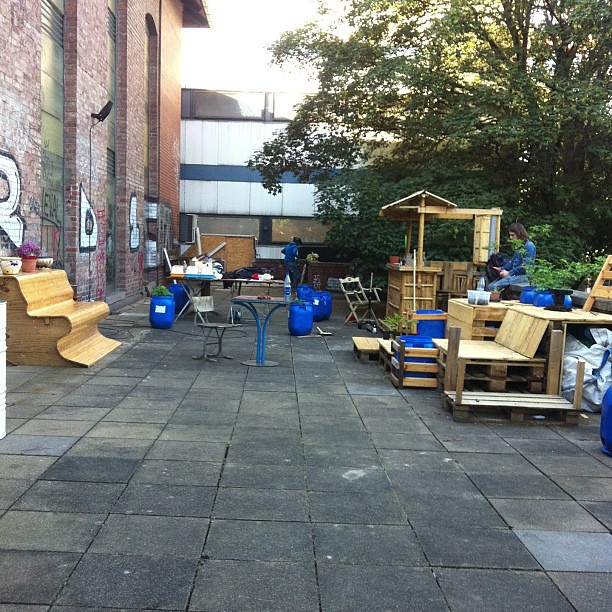
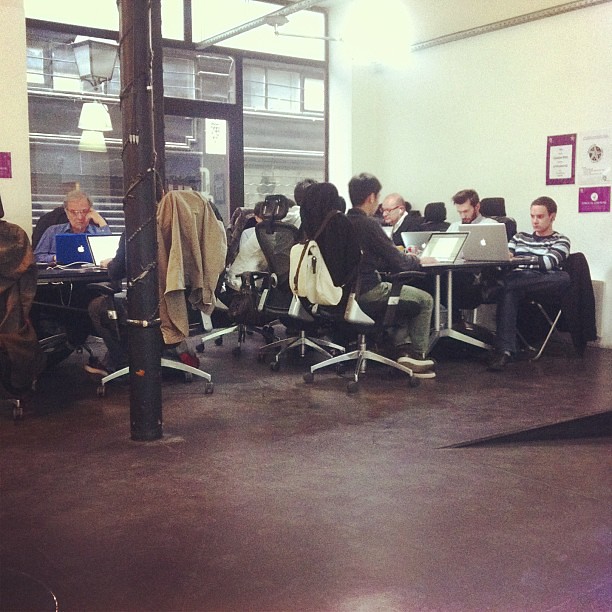
Kars ended the week with impromptu drinks with Sander and bits of Vlambeer and Monobanda while I spent Friday making the rounds of Amsterdam and visiting our friends over at Bruns&Niks and Hackers and Founders:
Let’s call it an appetizer for this Friday’s FATSEVEN.